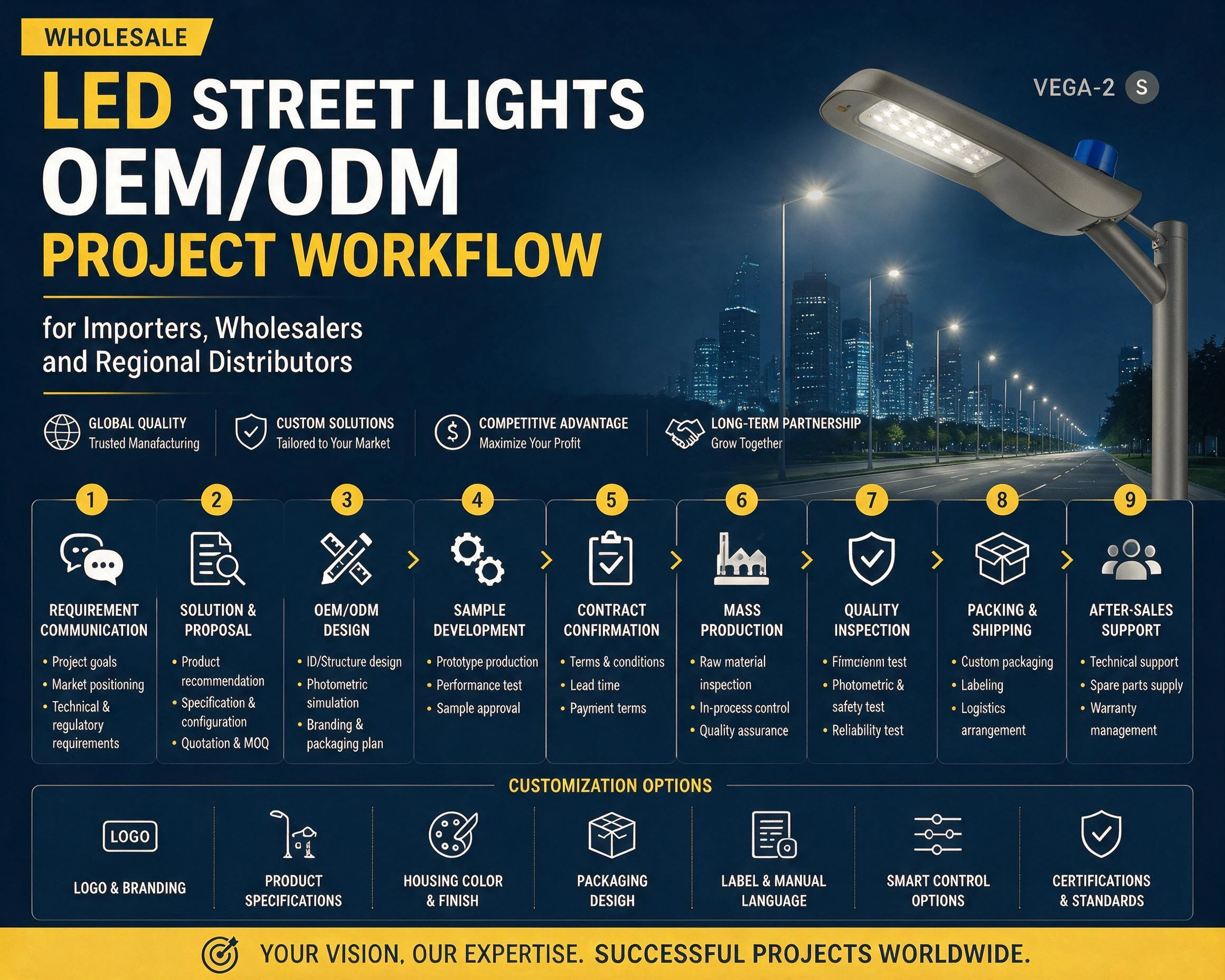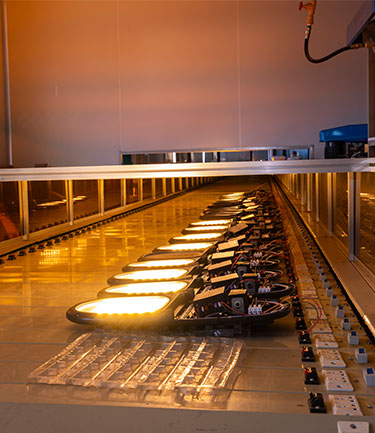

When choosing outdoor LED lights, people usually prioritize factors such as power, lumen output, protection level, and LED brand. However, there is an important safety classification that is often overlooked, which is Class I, Class II, and Class III.
This classification is used to distinguish the electrical protection schemes of the lamps. Do not confuse it with IP65/IP66, IK, etc., nor is it equivalent to energy efficiency or performance level.
Clarifying these concepts can help designers, contractors, and purchasers select suitable lamps for outdoor scenarios.
What Do Class I, Class II, and Class III Mean?
The IEC 60598 series of standards classify lamps into categories I, II, and III, mainly based on the ability to prevent electric shock. IEC 60598-1 is a general safety foundation standard, covering electrical construction, classification, marking, and various safety provisions.
In simple terms, the fundamental difference lies in the mechanism for protecting personnel in the event of an electrical fault.
| Class | Main Protection Method | MethodProtective Earth | EarthTypical Applications |
| Class I | Basic insulation + protective earthing | Required | Street lights, flood lights, industrial outdoor lighting |
| Class II | Double or reinforced insulation | Not required | Certain outdoor decorative and general lighting |
| Class III | Supplied by Safety Extra-Low Voltage (SELV) | Not normally required at the luminaire | Garden lights, decorative lighting, low-voltage systems |
Let’s look at each class in more detail.
Class I LED Light Fixtures
Class I lamps rely on basic insulation and are supplemented with protective grounding to achieve protection.
All metal conductive components that can be touched on the lamps must be connected to the protective grounding conductor. In case of insulation damage, the live parts touching the metal casing will cause the grounding to provide a path for the fault current, allowing the protection device to trip and cut off the power promptly.
Typical features
It is essential to ensure proper grounding
The metal casing must be connected to the PE protective ground wire
It is widely used in various fixed outdoor lamps
Very common in high-power lighting systems
The installation of the protective conductor must not be incorrect
Class I structures are widely used in LED street lamps, road lights, industrial floodlights and other fixed outdoor lighting.
For example, pole-mounted LED street lamps with aluminum casings and AC drivers are mostly of Class I design.
However, there is one thing to note: during outdoor project installations, the grounding connection must be firm. If the ground wire is not connected properly or disconnected, Class I lamps will not achieve the desired protective effect.
Class II LED Light Fixtures
Class II lamps do not rely on protective grounding for electrical shock protection.
Their protective measures are double insulation or reinforced insulation.
Even if the basic insulation is damaged, there is an additional set of insulation structures to prevent the external accessible metal parts from carrying dangerous voltages.
Class II lamps are generally marked with a double-box symbol.
The advantages of Class II lamps
The most obvious point is that it does not need to rely on grounding conductors for protection.
This can simplify many on-site installations, especially in situations where grounding is difficult to achieve on-site, which will be much more convenient.
However, it should be noted that Class II is not just about thickening the insulation layer. The entire electrical and mechanical structure must meet the corresponding insulation, creepage distance, electrical clearance, and structural hard requirements.
Class II design is applied in many LED products, such as some outdoor decorative lamps, and other lamps using double/ reinforced insulation also belong to this category.
Class III LED Light Fixtures
The design logic of Class III lamps is quite simple. They are specifically designed to be compatible with safety special low voltage (SELV) power supply.
They neither rely on grounding protection nor on the double insulation at the power supply end. Instead, they fundamentally reduce the risk of electric shock by limiting the working voltage.
The applicable scenarios of these lamps are relatively fixed. They are mostly used in the following places:
garden lighting, outdoor decorative lights, low-voltage landscape lighting, some portable lighting equipment, and various battery-powered lamps.
However, there is one point that is particularly prone to being misunderstood:
Class III lamps do not represent absolute safety or zero risk. The SELV power supply and the accompanying driver are themselves a key part of the entire safety system. The entire installation project must also strictly comply with the corresponding specification requirements and cannot be taken lightly.

Class I vs. Class II vs. Class III
To quickly distinguish the differences among the three types of lamps, it is sufficient to look at the core protective principle:
Class I lamps: Use basic insulation combined with protective grounding to achieve electric shock protection
Class II lamps: All protection is done by double insulation or enhanced insulation, without the need for grounding
Class III lamps: Rely on SELV (Special Earth-Low Voltage) power supply with a safe low voltage, avoiding risks at the voltage level
In fact, there is no absolute superiority or inferiority in lamp selection. There is no such thing as which type is better. Ultimately, the choice depends mainly on the design of the lamps, the power supply method, the installation scenario, and also needs to be in line with local electrical regulations and the specific construction standards of the project.
Class Rating Is Not the Same as IP Rating
When choosing outdoor LED lighting fixtures, this is one of the most common cognitive mistakes that people tend to make.
Many people confuse the category of lamp safety and the protection level, but in fact, the performance defined by the two is completely different. Class I, II, and III lamps specifically refer to the methods of protecting against electric shock for the equipment, while the IP level is only used to measure the dust and water resistance.
Take a very common example, an outdoor LED street lamp, its parameters are often a combination of Class I + IP66.
These two sets of parameters have their own functions and are not related to each other:
Class I represents the electrical shock protection mechanism of the lamp, IP66 corresponds to the dust and water resistance performance, and parameters like IK08 are used to determine the lamp’s resistance to mechanical impact.
So, everyone must pay attention: merely seeing the IP66 protection level cannot determine whether the lamp belongs to Class I, II, or III. The classification of the lamp’s electrical shock protection needs to be separately checked and evaluated, and cannot be generalized with the protection level.
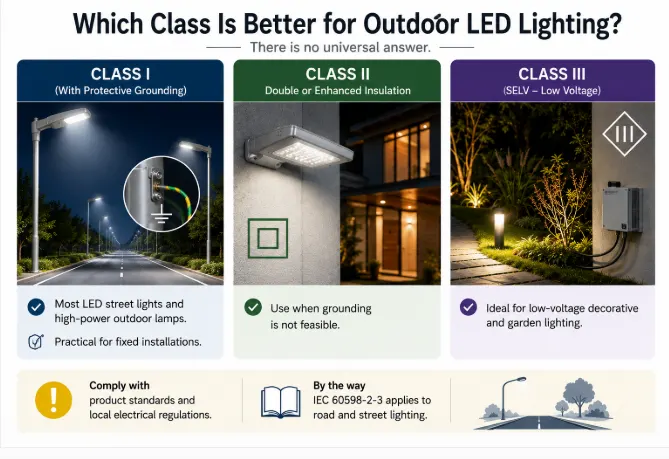
Which Class Is Better for Outdoor LED Lighting?
In fact, there is no universal answer.
LED street lights and various high-power outdoor lamps mostly use type I. With a metal casing and protection grounding, this is a very practical solution for fixed installation scenarios.
If it is not feasible to perform grounding on-site or the conditions are not allowed, qualified type II lamps can be used as a substitute.
For low-voltage decorative lights and garden lighting, if the entire system is built around the SELV power supply, type III lamps would be more suitable.
No matter which type is chosen, it must comply with the corresponding product standards and also meet the electrical regulations of the target market.
By the way, there is a specific IEC 60598‑2‑3 standard for road and street lighting. This standard sets special requirements for these public outdoor lamps.
What Should Buyers Check Before Purchasing?
When evaluating outdoor LED lamps, don’t just focus on the IP protection grade. A truly comprehensive technical assessment requires considering multiple key indicators.
Specifically, you can refer to these core evaluation dimensions:
Electrical protection category, also known as Class I, II, and III protection; IP dust and water resistance grade; IK anti-mechanical impact performance; AC and DC input voltage range; overvoltage, overcurrent, and overtemperature protection functions built into the driver; overall electrical insulation safety; equipment operating temperature, surge protection capability, as well as the IEC/EN standards and actual installation conditions to which the lamps are adapted.
Especially in street lighting projects, these elements complement each other and directly determine the safety and stability of the lamps’ long-term operation.
Conclusion
Class I, Class II, and Class III lamps correspond to three completely different protection schemes against electric shock.
To simply distinguish them: Class I relies on grounding protection, Class II ensures safety through double insulation or reinforced insulation, while Class III avoids the risk of electric shock by providing safe extremely low voltage power supply.When choosing outdoor LED lighting, there is no so-called optimal category. Don’t assume that one category is better without thinking. In reality, it is necessary to comprehensively judge by considering the lamp structure design, the entire electrical system, the on-site installation conditions, and the corresponding industry standards.