Why Roadway Lighting Projects Fail Before Installation
Poor roadway lighting design can create more than dark roads. Incorrect illuminance targets, excessive glare, uneven spacing, or unverified photometric data can trigger specification conflicts, redesigns, project delays, and higher lifetime maintenance costs. For DOTs, municipalities, and EPC contractors, the risk is especially high because lighting must balance public safety, compliance, energy efficiency, installation constraints, and long term reliability. A fixture that looks economical at purchase can become expensive if its optical performance does not match the road geometry. The right design starts with measurable lighting targets and verified photometric performance.
For roadway lighting fixtures, the best selection starts with project specific illuminance or luminance targets, uniformity requirements, pole geometry, optical distribution, and verified photometric data. Luxific combines customizable LED street light designs, multiple Type I to V distributions, IP66 construction, and project engineering support to help DOT, municipal, and EPC teams evaluate performance before installation.
1. Set Illuminance, Luminance and Uniformity Targets First
Roadway lighting should begin with the performance required on the road, not with a preferred wattage or fixture model. The project team should define the target lighting level, uniformity, road classification, traffic conditions, pedestrian requirements, and local specification before choosing the luminaire.
Illuminance versus Luminance
Illuminance describes the amount of light reaching a surface and is commonly expressed in lux. Luminance describes the brightness perceived from the road surface in the viewing direction and is particularly relevant when roadway design specifications are based on luminance criteria. The correct calculation method should follow the applicable DOT, municipal, or project standard.
| Design input | Why it matters | What the supplier should confirm |
|---|---|---|
| Illuminance or luminance target | Defines required road visibility | Calculation method and target values |
| Uniformity | Reduces dark zones and visual contrast | Average, minimum, and required uniformity ratios |
| Road width | Influences optical distribution and spacing | Fixture arrangement and mounting geometry |
| Traffic and pedestrian conditions | Influences safety requirements | Road classification and application |
Use the Lowest Lifetime Cost as the Decision Principle
For municipalities and EPC contractors, the lowest purchase price is not always the lowest project cost. Energy consumption, replacement frequency, maintenance access, spare parts, and installation labor all influence total ownership cost. Luxific focuses on energy efficient outdoor LED lighting and provides customizable solutions for municipal and infrastructure applications. Its project portfolio includes municipal roadway modernization where smart LED street lights and scheduled dimming helped reduce energy consumption and maintenance activity.
2. Determine Pole Height, Spacing and Arrangement
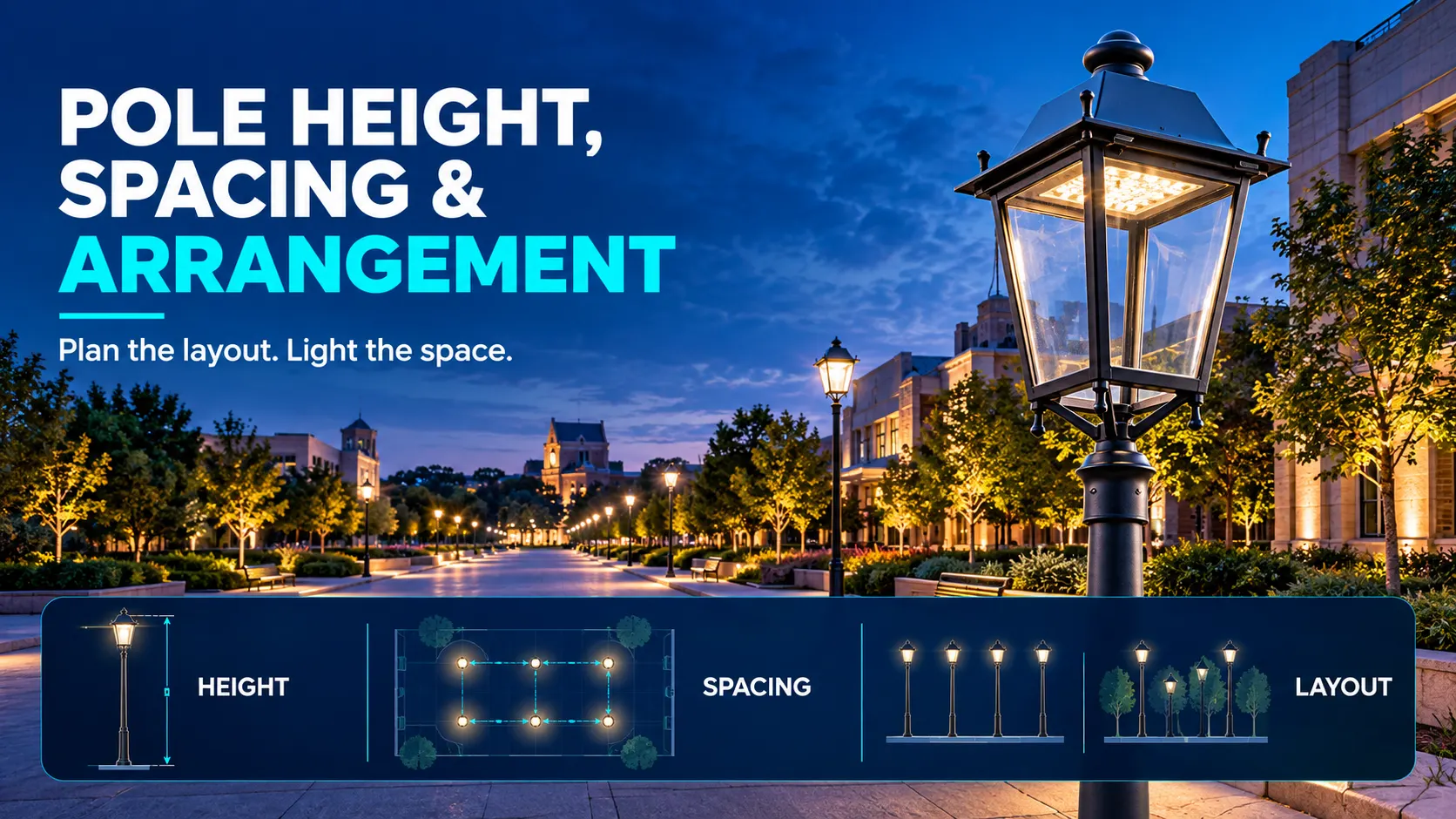
Even a high quality LED street light can perform poorly if pole geometry is wrong. Pole height, road width, setback, mounting angle, arm length, and pole spacing should be evaluated together because changing one variable affects the required optical distribution and lighting uniformity.
Start With Road Geometry
- Measure the total carriageway width and individual lane arrangement.
- Record the proposed pole height, setback, outreach, and mounting angle.
- Identify intersections, curves, pedestrian crossings, bridges, ramps, and other critical areas.
- Define the required spacing based on the lighting calculation rather than using a fixed spacing rule.
- Run a photometric simulation and adjust fixture power, optics, height, or spacing until the required targets are achieved.
Luxifics roadway lighting guidance identifies road width, location, purpose, light spread, and regulatory requirements as important factors when determining street light height and arrangement. The company also notes that LED fixtures can support efficient coverage while helping designers manage glare and shadows.
Typical Design Tradeoffs
| Design choice | Potential advantage | Potential concern |
|---|---|---|
| Higher pole | Broader coverage and fewer poles | Higher structural and maintenance requirements |
| Lower pole | Easier maintenance and potentially lower structural cost | May require closer spacing |
| Wider spacing | Fewer poles and reduced installation quantity | Can create dark areas if optics are unsuitable |
| Higher output | More available luminous flux | Can increase glare, energy use, or overlighting |
3. Select Type I to V Optics and Cutoff Carefully
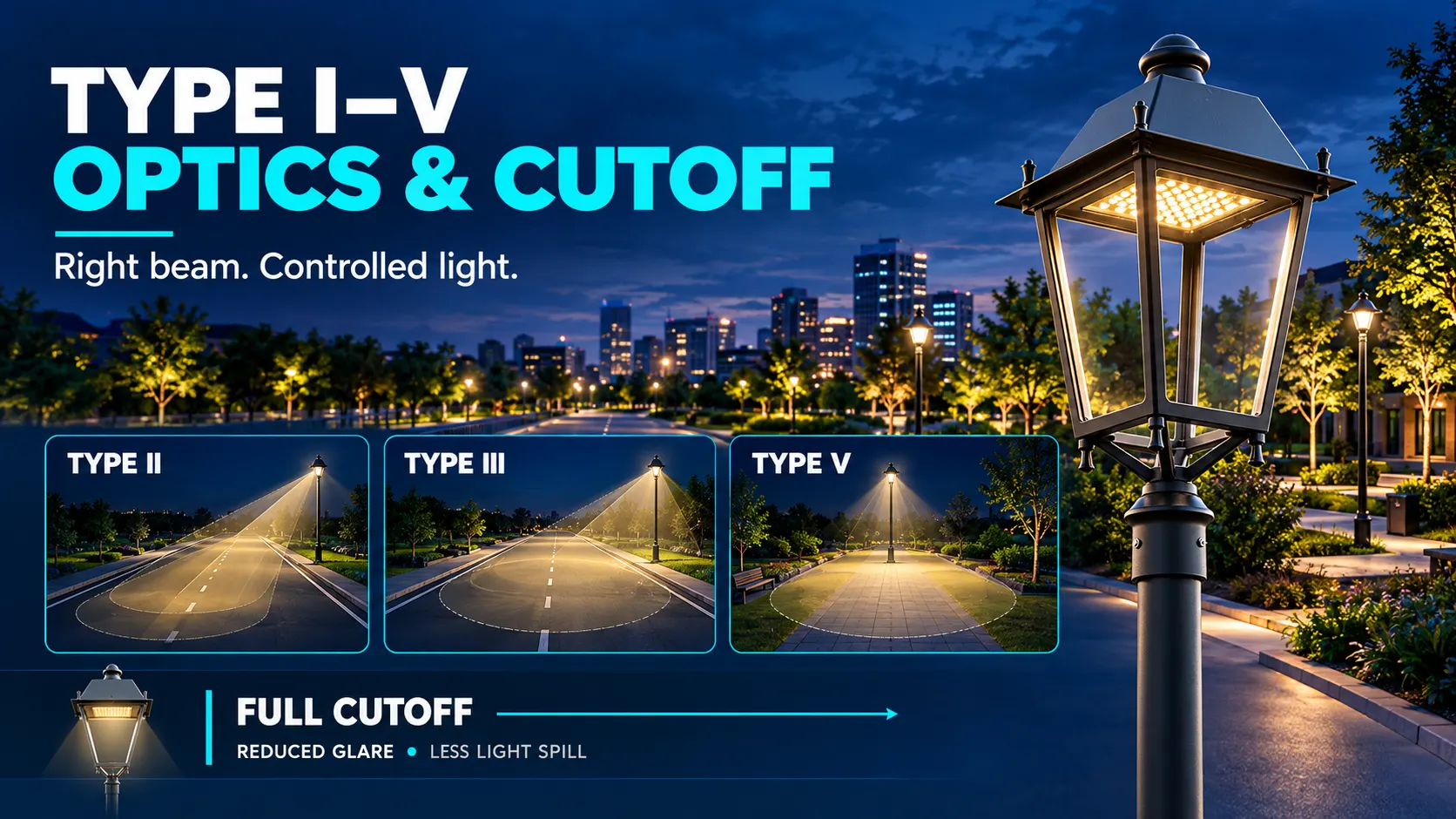
Optics determine where the light goes. For roadway projects, choosing a luminaire only by wattage or lumen output is not enough. The optical distribution should match the road width, pole position, spacing, mounting height, and required uniformity.
Match the Distribution to the Road
- Type I can be considered for narrower roadway or pathway arrangements where a concentrated distribution is appropriate.
- Type II can support broader coverage near road edges and conventional roadway layouts.
- Type III is useful where wider forward distribution is needed for roadway coverage.
- Type IV is generally associated with broader lateral distribution and can be considered for specific mounting arrangements.
- Type V provides a more symmetrical distribution and can be appropriate for certain central or area based mounting conditions.
These classifications should not be selected in isolation. The final choice must be confirmed through the actual photometric distribution and project calculation. Luxifics roadway fixture platform provides multiple Type I to V optical distributions designed to support tailored illumination, reduced glare, and improved uniformity.
Consider Cutoff and Glare Control
DOT and municipal projects increasingly need to control glare, light trespass, and unnecessary upward light. Proper optics, aiming, shielding, and mounting geometry can direct light toward the roadway instead of surrounding properties or drivers.
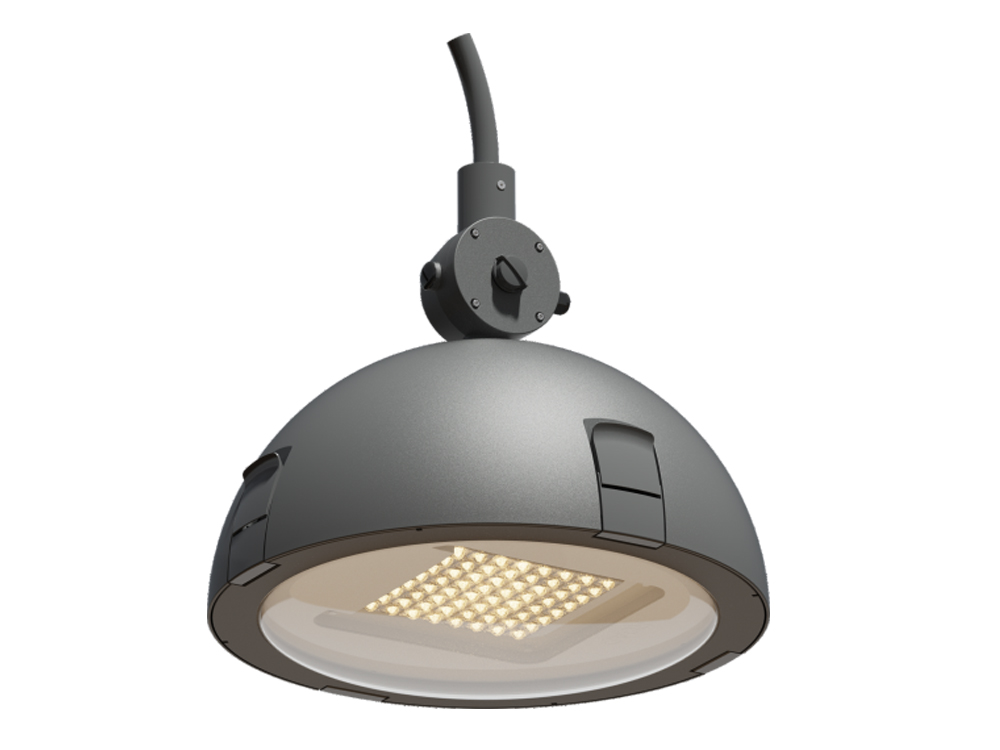
Luxific roadway fixtures are designed with precision optical control and multiple distribution options. A representative roadway fixture uses a die cast aluminum body, IP66 protection, IK09 impact protection, and 10KV, 10KA surge protection, with optional photocell, NEMA socket, and ZHAGA interfaces.
4. Validate the Design With IES and LDT Photometric Files
A specification should not rely only on a product datasheet showing watts, lumens, or efficacy. For a professional roadway project, the design team should request the photometric file and use it in lighting calculation software to evaluate the actual installation.
What to Check
- Confirm the exact fixture model and optical distribution.
- Load the IES or LDT photometric file into the calculation software.
- Enter actual pole height, spacing, setback, road width, mounting angle, and fixture orientation.
- Review average illuminance or luminance against the project requirement.
- Check minimum values and uniformity rather than relying only on average results.
- Review glare, spill light, and areas outside the roadway where required.
- Save the calculation report as part of the project approval documentation.
Do Not Confuse Product Data With Project Performance
A fixture rated at a high lumen output does not automatically guarantee good roadway performance. Two luminaires with similar wattage can produce very different results because their optics, mounting conditions, and distributions are different. Photometric validation converts product data into project specific evidence.
Luxific states that its engineering services include technical design, prototyping, quality control, and project support. Its roadway product information also identifies multiple optical distributions and international testing or certification references including CE, CB, ENEC, EMC, TM21, LM79, IEC 62471, IP66, and IK09 for the specified product platform.
5. Build the Specification Around Reliability and Compliance
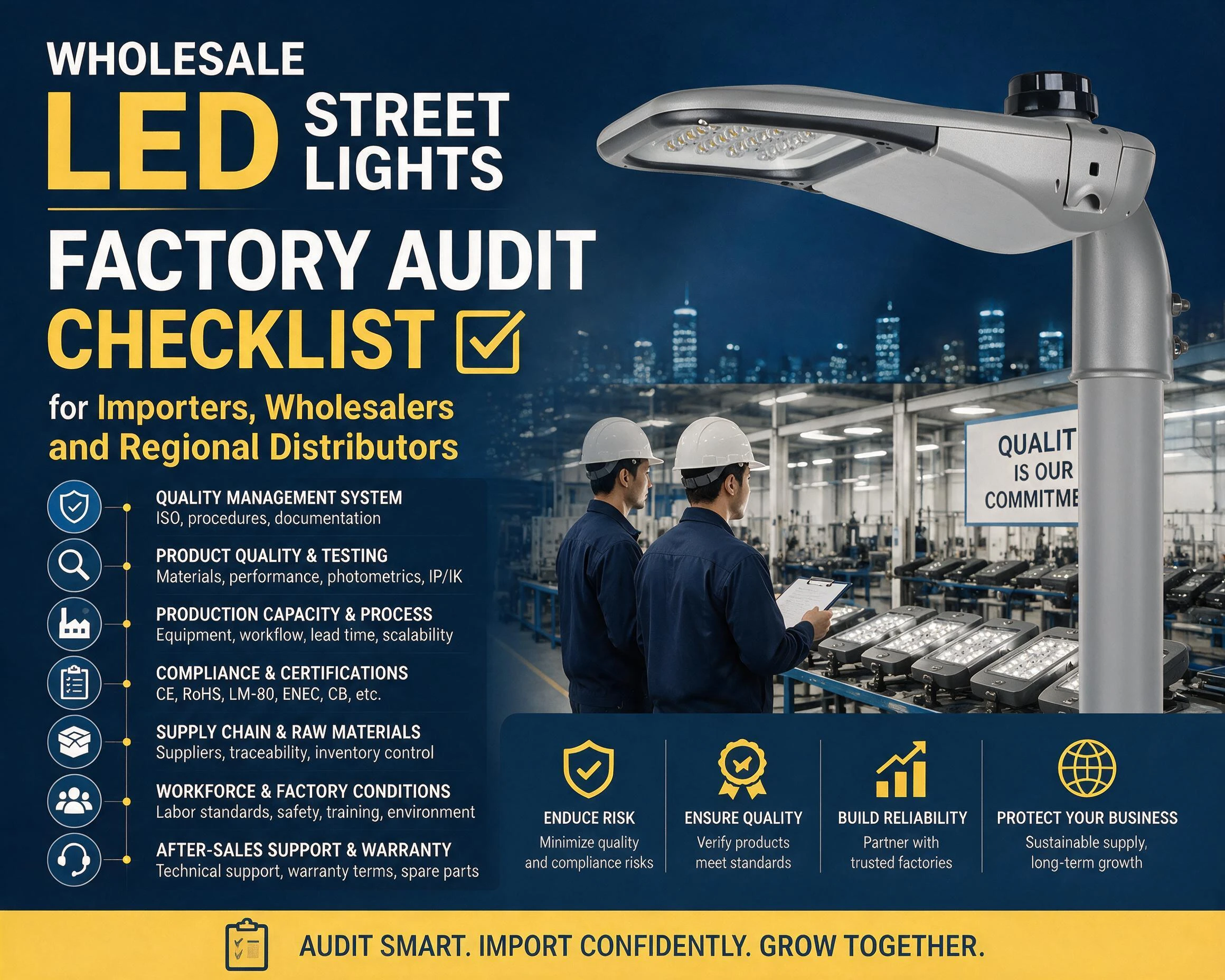
For a DOT, municipal authority, or EPC contractor, a roadway lighting specification should cover more than optical performance. The supplier should be able to provide consistent production, certification documents, technical communication, warranty support, and delivery coordination.
Supplier Evaluation Checklist
- Verified photometric files and technical documentation
- Relevant product and safety certifications
- Defined ingress and impact protection
- Surge protection appropriate to the project environment
- Driver and component quality documentation
- Warranty and after sales support
- Production capacity for the required quantity
- Clear communication during sampling and approval
- OEM or ODM capability when project specifications require customization
- Reliable delivery planning for project deadlines
Luxific has operated since 1999 and identifies itself as a professional LED outdoor lighting Manufacturer and Supplier. Its documented certifications include GS, CE, CB, RoHS, ISO 9001, ISO 14001, and ISO 50001, while its OEM and ODM service covers project oriented design, dimensions, materials, colors, branding, packaging, prototyping, and technical development.
For Wholesalers and Project Contractors
A Wholesaler or EPC contractor may need a repeatable luminaire platform rather than a one time product purchase. Luxific supports customizable project solutions and large volume supply, allowing customers to specify application requirements and branding needs. For projects requiring a private label or market specific product, OEM and ODM options can be incorporated into the procurement process.
6. A Practical Roadway Fixture Selection Workflow
- Collect road width, pole height, spacing, setback, mounting angle, and project location.
- Confirm the applicable DOT, municipal, or EPC lighting specification.
- Define illuminance or luminance targets and uniformity requirements.
- Select an initial LED street light power and Type I to V optical distribution.
- Request the matching IES or LDT photometric file and technical datasheet.
- Run the complete photometric calculation using the actual site geometry.
- Adjust optics, power, pole arrangement, or mounting parameters where necessary.
- Confirm certification, surge protection, environmental ratings, warranty, quantity, and delivery requirements.
- Approve the final sample and documentation before mass production.
Conclusion
Send Luxific your road dimensions, pole height, target illuminance or luminance, required quantity, market certifications, and delivery date. Our engineering team can help evaluate the appropriate roadway lighting fixtures, optics, customization, and project configuration for your specification.