Why Poor Roadway Lighting Design Can Increase Project Risk
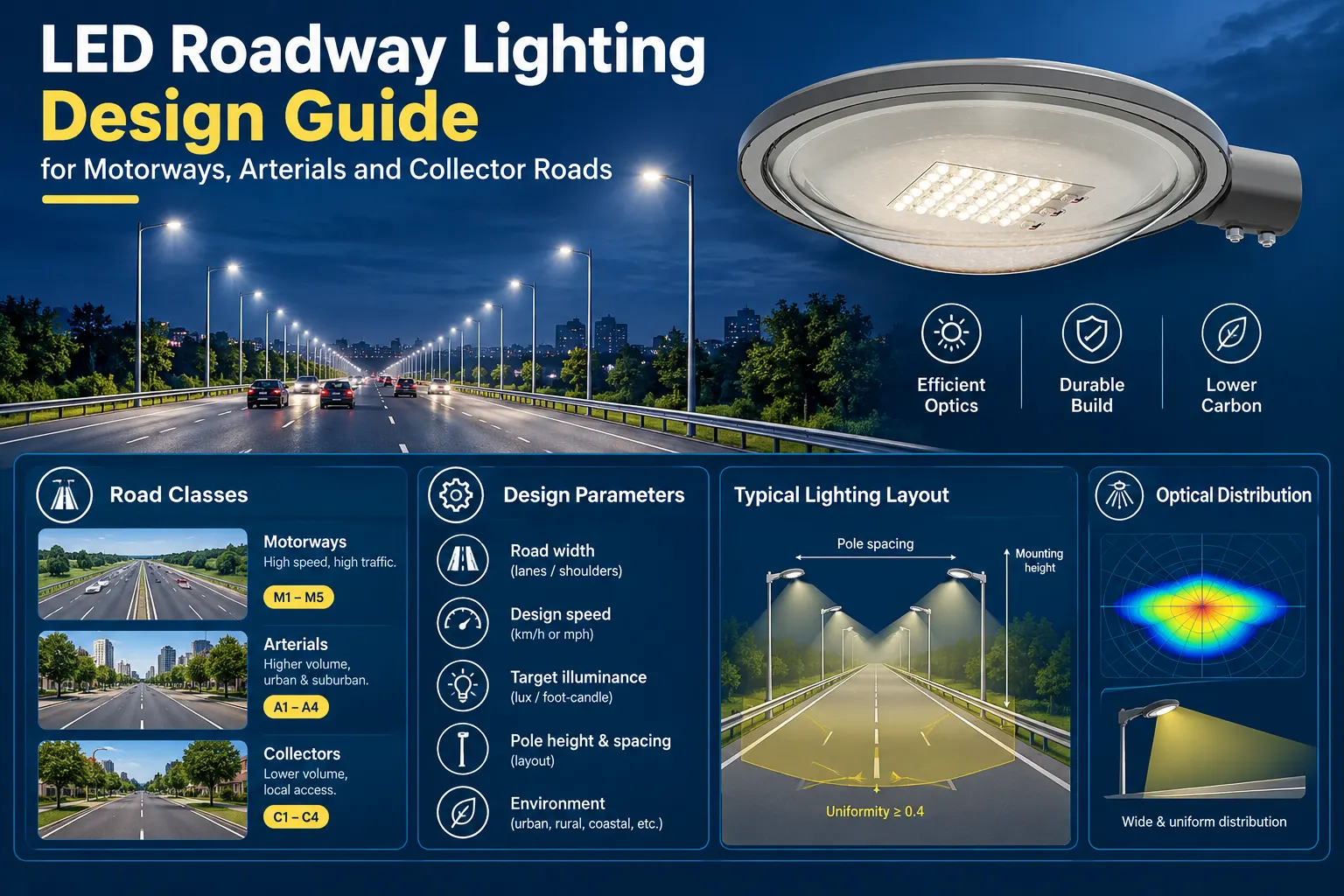
Choosing roadway lighting by wattage or purchase price alone can create uneven illumination, excessive glare, wasted energy, and difficult maintenance. On motorways, arterials, and collector roads, these problems become project risks when pole height, spacing, road width, traffic conditions, and lighting targets are not considered together. For municipalities, EPC contractors, and lighting integrators, the consequences can include redesigns, compliance issues, delayed installation, and higher lifetime costs. The safer approach is to start with the road geometry and lighting requirements, then validate optics and photometric performance before finalizing the fixture.
The right LED roadway light should be selected by illuminance or luminance targets, uniformity, pole geometry, Type I–V optics, glare control, and validated IES or LDT photometric data. Luxific provides Customizable LED street lighting with OEM and ODM support for project and wholesale requirements.
1. Start With Illuminance, Luminance and Uniformity Targets
Roadway lighting design should begin with the performance required on the road, not with a fixture model. The exact criteria depend on the road classification, traffic conditions, local regulations, and project specification.
Illuminance Versus Luminance
Illuminance describes the amount of light arriving on the road surface, while luminance considers the brightness perceived from the road surface by drivers. A professional design may use either approach depending on the applicable standard and project requirements.
- Illuminance: Useful for evaluating light delivered to the pavement.
- Luminance: Particularly relevant where driver visual performance and road-surface brightness are central to the design.
- Uniformity: Shows how evenly light is distributed and helps avoid strong bright and dark zones.
- Glare control: Important for driver comfort, especially on high-speed roads.
Typical Design Inputs
| Input | Why It Matters | What the Buyer Should Provide |
|---|---|---|
| Road class | Determines the required lighting approach | Motorway, arterial, collector or other classification |
| Target lighting level | Defines required photometric performance | Required illuminance or luminance and uniformity |
| Road width | Influences optical distribution and mounting arrangement | Carriageway width and number of lanes |
| Traffic conditions | Influences lighting requirements and controls | Traffic volume, speed and operating schedule |
2. Match Pole Height, Spacing and Arrangement
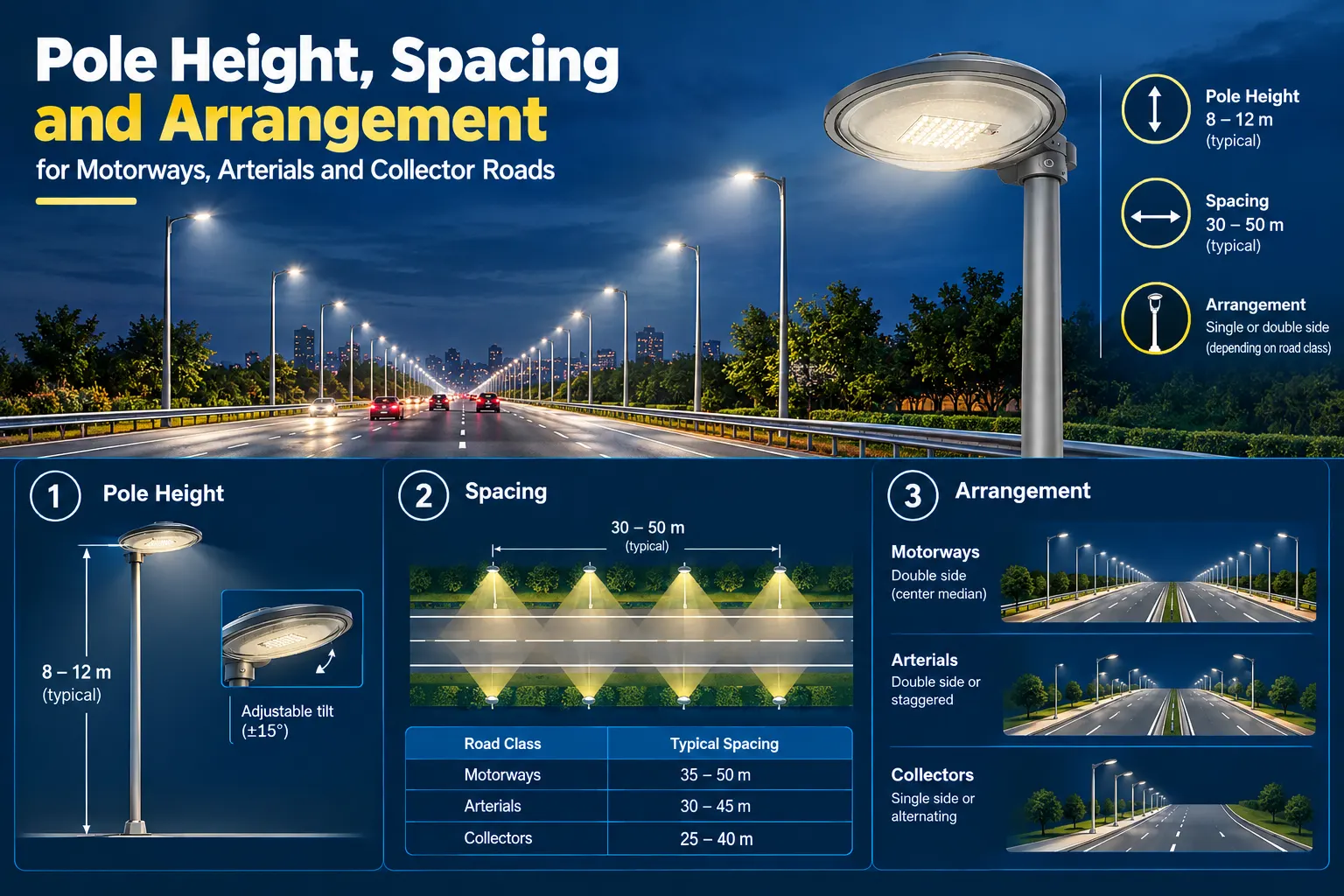
The same LED roadway luminaire can produce very different results when installed at different heights or spacing. Pole geometry must therefore be considered together with the optical distribution and lumen output.
Key Pole Parameters
- Pole height: Higher mounting generally requires an optical distribution capable of projecting light over a larger area.
- Pole spacing: Excessive spacing can create dark areas, while unnecessarily close spacing may increase project cost.
- Setback: The distance between the pole and road edge affects the required beam direction.
- Arrangement: Single-side, staggered, opposite-side, median-mounted, and central arrangements each require different photometric evaluation.
- Mounting angle: The luminaire tilt can affect forward throw, glare, and the final light pattern.
Design by Road Geometry
For a Wholesaler or project contractor, the most useful specification package includes road width, pole height, pole spacing, mounting arrangement, setback, and target lighting level. Providing these details allows the Supplier to recommend an appropriate configuration instead of simply matching a wattage to the project.
Luxific positions its roadway lighting around flexible application requirements, with LED street lights designed for roads and other outdoor infrastructure applications. Its product portfolio also supports Customizable solutions, while OEM and ODM services are available for project-specific requirements.
3. Select Type I–V Optics and Control the Cutoff
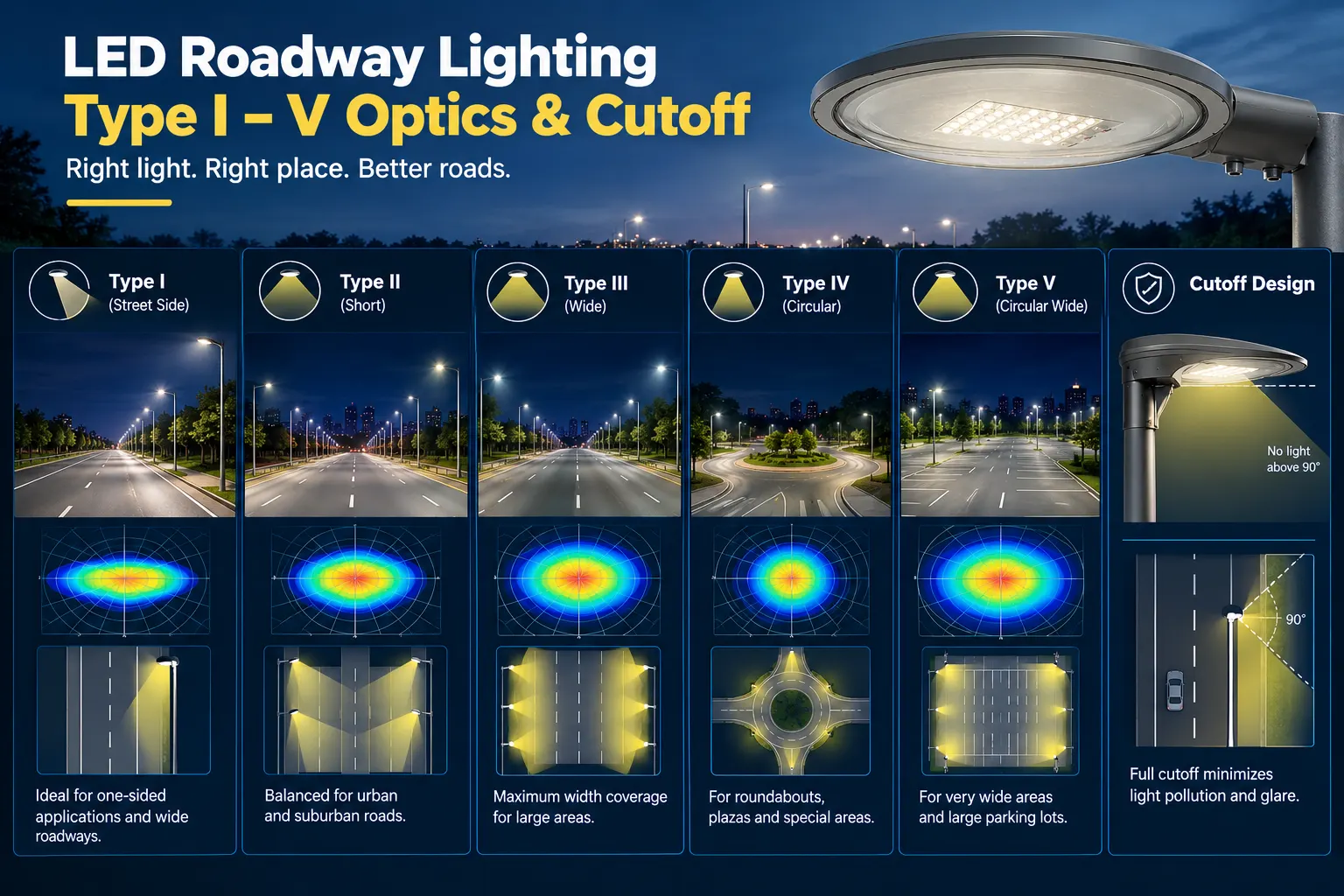
Optics determine where the light goes. For roadway projects, selecting the correct optical distribution is often more important than simply increasing wattage. The objective is to place sufficient light on the required road area while limiting unnecessary spill light and glare.
Understanding Type I–V Roadway Optics
| Optical Type | General Application Consideration | Design Focus |
|---|---|---|
| Type I | Narrow roadway or pathway applications | Controlled distribution near the luminaire |
| Type II | Roadways with moderate width | Forward and lateral coverage |
| Type III | Wider roadway applications | Broader forward distribution |
| Type IV | Applications requiring stronger forward projection | Longer throw and edge coverage |
| Type V | Central or wide-area mounting arrangements | More symmetrical distribution around the mounting position |
Actual selection should always be based on the road geometry and photometric calculation rather than the optical type name alone. Luxific roadway products include models with multiple optical distributions, allowing the lighting configuration to be adapted to different road and outdoor applications.
Cutoff and Glare Considerations
Good roadway optics should concentrate light where it is needed. Excessive upward or lateral spill can increase glare and light pollution without improving road visibility. For motorways and major arterials, the optical design should therefore be reviewed together with mounting height, tilt angle, setback, and surrounding environment.
Ask for the Complete Optical Information
- Available Type I–V distributions
- Beam characteristics and optical files
- Recommended mounting height
- Recommended pole spacing
- Mounting angle and bracket information
- Glare and spill-light considerations
4. Validate the Design With IES or LDT Photometric Files
A product datasheet can show wattage, lumens, efficacy, dimensions, and certifications, but it cannot replace a photometric calculation. IES and LDT files provide the digital photometric information needed by lighting design software to simulate how the fixture performs in the actual road layout.
What to Validate Before Ordering
- Import the correct IES or LDT file into the lighting calculation software.
- Enter the actual road width, pole height, spacing, setback, and mounting arrangement.
- Set the required illuminance or luminance criteria.
- Check average lighting levels and uniformity.
- Review areas between poles, road edges, intersections, and other critical zones.
- Evaluate glare and unnecessary light spill where required.
- Confirm that the selected configuration meets the project specification before mass production.
Why Photometric Validation Matters for Buyers
For a project buyer, photometric validation reduces the risk of selecting a fixture that looks suitable on paper but performs differently after installation. It also gives the contractor, municipality, lighting integrator, and Manufacturer a common technical reference before production.
Luxific states that its engineering services can support project-specific technical design, prototyping, quality control, and logistics. Its project materials also describe the use of photometric analysis for customized outdoor lighting applications.
5. Consider Efficiency, Maintenance and Compliance Together
Roadway lighting is a long-term infrastructure purchase. The lowest initial fixture price does not necessarily produce the lowest total cost. Buyers should evaluate energy consumption, maintenance access, product durability, warranty support, documentation, and compliance requirements together.
Buyer Checklist
- Confirm required lighting levels and uniformity.
- Match the optical distribution to the road geometry.
- Validate the design using IES or LDT photometric data.
- Check the fixture power, lumen output, and expected maintained performance.
- Review ingress and impact protection for the installation environment.
- Confirm required market certifications and testing documents.
- Check control options if dimming or smart-city integration is required.
- Confirm warranty, spare parts, technical support, and maintenance arrangements.
- Review production capacity and delivery schedule before placing the project order.
Luxific describes its LED outdoor lighting products as supported by international certifications including GS, CE, CB and RoHS compliance, while its customization services cover product design, materials, dimensions, colors, branding, packaging, prototyping, quality control, and logistics. Buyers should always confirm the exact certification package required for their target market and project.
6. Choose a Roadway Lighting Partner for the Full Project
For municipal projects, EPC contractors, infrastructure contractors, public lighting companies, and lighting distributors, supplier capability matters beyond the luminaire itself. A reliable Manufacturer should be able to communicate clearly, provide technical documentation, support project customization, maintain quality control, and coordinate production with the required delivery schedule.
Luxific operates as an LED outdoor lighting Manufacturer and Supplier, with a product range covering LED street lights, solar street lights, smart street lights, highway lights, tunnel lights, and bridge lighting. Its documented OEM and ODM capability allows project-specific customization for appearance, dimensions, materials, colors, branding, and related requirements.
Conclusion
Start your roadway lighting project with real site data. Submit road dimensions, pole height, target illuminance, quantity, required market certifications, and delivery date to Luxific. Our team can use these inputs to recommend a suitable configuration and prepare a project quotation.