During the installation and operation of street lighting projects, fixture problems are usually caused by damage to core components such as LED chips, drivers, and power supplies. However, some faults do not originate from these core components, but from external accessories on easily overlooked NEMA or Zhaga interfaces.
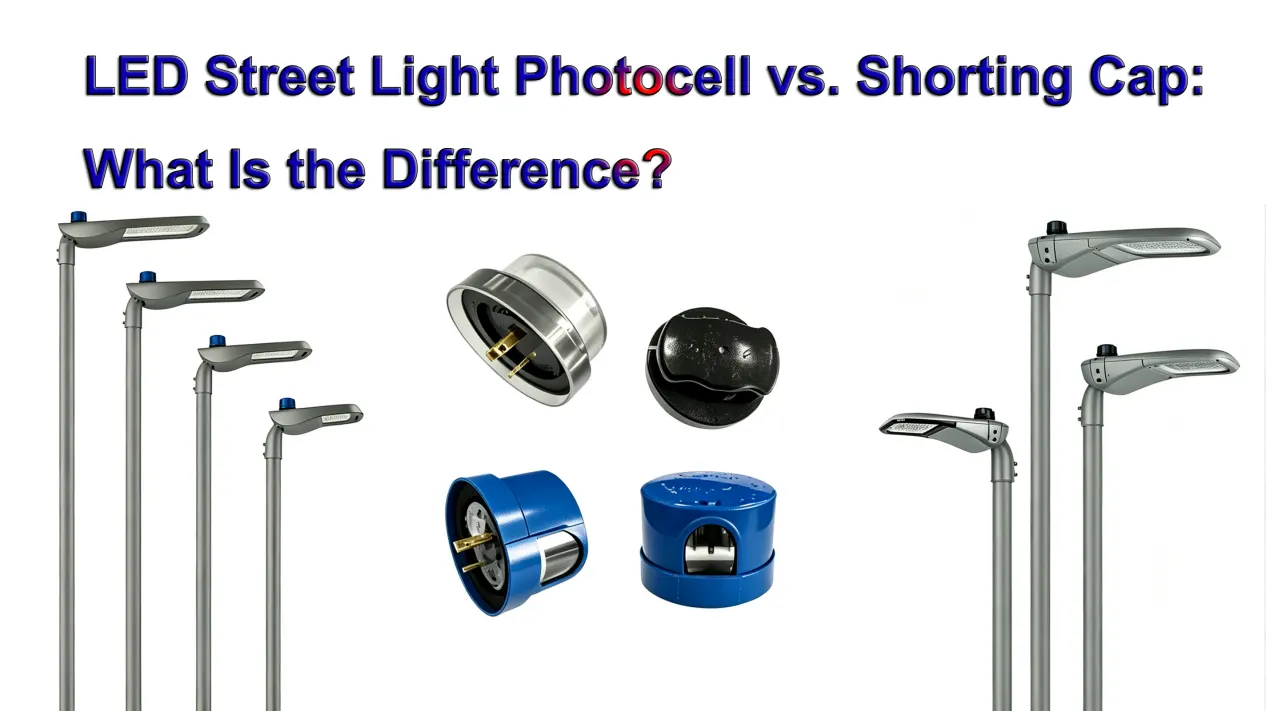
Photocells and Shorting Caps are two external accessories that are relatively easy to confuse. They are similar in appearance and installation method, but their functions and operating principles are completely different.
If the wrong accessories are selected in the BOM, or accessories are replaced on site without confirmation, the fixture may stay on continuously, operate abnormally at night, fail to respond to remote lighting commands, or experience scheduling problems. These issues can increase project commissioning, acceptance, and ongoing maintenance costs.
Therefore, correctly distinguishing between Photocells and Shorting Caps and selecting the appropriate accessory according to the fixture interface and control method is important for both conventional and smart street lighting projects.

What Is the Difference Between a Photocell and a Shorting Cap?
1. Operating Principle
Photocell: An Automatic Switch That Can “See” the Light
A Photocell is an automatic switch that can “see” the light. It contains a light-sensing element and control circuitry that can detect changes in surrounding light.
When the light is strong during the day, it knows that it is “daytime” and turns the light off. When the light becomes weaker at night, it knows that it is “nighttime” and turns the light on.
It is an intelligent, self-operating switch—similar to a person who can make decisions on their own.
Shorting Cap: A Regular Switch That Cannot “See” the Light
A Shorting Cap is a regular switch that cannot “see” the light and needs to be controlled by another system.
It does not contain a light-sensing element or control circuitry. It does not know whether it is daytime or nighttime, nor does it know whether the light should be turned on or off. It needs another system to control when the light turns on or off.
It is a switch without independent decision-making—like a puppet that follows someone else’s commands.
2. Control Differences
With a Photocell:
Daylight → Strong light detected → Light OFF → Nighttime → Low light detected → Light ON → Makes the decision automatically
With a Shorting Cap:
Waits for another control system to determine whether the light should turn ON or OFF → Cannot make the decision independently
3. Application Differences — Directly Related to BOM Selection
Photocell
Photocells are mainly used for conventional street lights, residential courtyard lights, and general outdoor roadway lighting without a smart control system.
The fixture relies on the Photocell’s built-in light-sensing function to independently turn the light on at night and off during the day.
This solution is suitable for conventional lighting projects that prioritize a simple solution, low cost, and minimal ongoing maintenance.
Shorting Cap
Shorting Caps are mainly used for smart street lighting projects equipped with NEMA/Zhaga smart gateways or wireless control modules.
Installing a Shorting Cap bypasses the local photocell control function and transfers control of the fixture to another control system. This enables centralized road lighting management, remote platform scheduling, dimming, timing control, fault reporting, and other smart lighting functions.
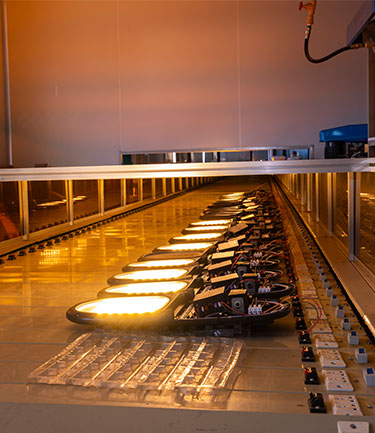
Shorting Caps are also widely used for fixture factory aging tests, temporary power-on during on-site commissioning, and smart lighting retrofit projects.
4. Consequences of Incorrect Selection — Common Engineering Problems
Smart Street Light Incorrectly Installed with a Photocell
If a smart street light is already controlled by a smart controller or management platform, but a Photocell is also installed, two control methods may end up controlling the same fixture.
The Photocell can automatically control the street light according to day and night, while the smart platform also sends ON, OFF, or scheduled commands.
If the two control methods are inconsistent, the fixture may switch abnormally, scheduled tasks may not execute correctly, and remote control may fail, affecting project commissioning and acceptance.
Conventional Street Light Incorrectly Installed with a Shorting Cap
If a conventional street light is incorrectly installed with a Shorting Cap, it will directly bypass and disable the light-sensing function.
The street light, which originally had the ability to independently determine when to turn on or off, is forced into a state where it can no longer make decisions on its own.
At this point, the fixture loses its ability to distinguish between day and night, and the circuit may remain continuously energized, resulting in a 24-hour continuous lighting fault.
This not only causes significant unnecessary electricity consumption, but also accelerates the aging and degradation of the LED light source and driver due to continuous operation, significantly shortening the service life of the fixture.
It may also lead to customer complaints and on-site rework, making it one of the most common accessory selection mistakes in conventional street lighting projects.
5. When Should You Use a Photocell and When Should You Use a Shorting Cap?
Use a Photocell
Use a Photocell when:
• The project is a conventional street lighting, courtyard lighting, or outdoor park lighting project.
• There is no smart control system, gateway, remote platform, or centralized control cabinet.
• The fixture needs to operate independently, automatically turning on at night and off during the day without manual operation.
• The project prioritizes a simple solution and limited budget.
• The fixture is expected to operate automatically based on its own hardware.
• There are no plans to upgrade the project to smart street lighting in the future.
• The fixture does not need to be controlled by external equipment.
Use a Shorting Cap
Use a Shorting Cap when:
• The project is a smart street lighting project equipped with NEMA/Zhaga smart modules or wireless gateways and requires remote platform management.
• The entire road uses a centralized control cabinet or time-control system for unified scheduling, and individual fixtures should not be controlled by local light sensing.
• The fixture requires temporary bypassing of the photocell function during factory aging tests, on-site commissioning, or temporary power-on.
• An existing street lighting system is being upgraded to smart control, with the original Photocell removed and replaced by a Shorting Cap so that the smart system can take over control.
Conclusion
The two street lighting accessories have compatible interfaces but mutually exclusive functions. The key to selecting the right accessory depends on the project’s control method:
Conventional unattended automatic lighting projects → Photocell
Smart, centralized-control, or remote-management projects → Shorting CapProper BOM selection can effectively prevent many common on-site lighting problems and reduce rework and after-sales costs.