
Why are many LED street lights more likely to experience failures during the summer? Most maintenance personnel may instinctively assume that the failures are caused by damaged LED chips. However, driver aging and damage caused by high temperatures are also important reasons why street lights experience frequent failures in summer.
LED street lights are exposed to outdoor conditions for long periods. High ambient temperatures and direct sunlight can increase the temperature inside the fixture, causing internal components to remain at high or even excessive temperatures for extended periods. This can accelerate the aging and damage of internal components, affecting the normal operation of the street light.
What Does LED Street Light Overheating Mean?
When an LED street light operates, both the LED chips and the driver generate heat during light emission and electrical energy conversion. As long as the temperature remains within the specified operating range of the components, normal operation will not be affected.
LED street light overheating refers to a condition in which critical components inside the fixture remain at temperatures above their allowable operating range for an extended period.
High summer temperatures and direct sunlight, combined with an enclosed fixture housing and limited internal space, can reduce ventilation and heat dissipation efficiency. As a result, heat cannot escape efficiently and continues to accumulate inside the fixture, causing the LED driver to operate at high temperatures for an extended period.
However, an overheated LED street light does not necessarily fail immediately. Instead, it causes gradual, cumulative damage over time.
What Is Thermal Protection in an LED Driver?
Thermal protection in an LED driver is an active temperature protection mechanism designed to prevent the driver from being damaged by prolonged operation at high temperatures.
How Does Thermal Protection Work?
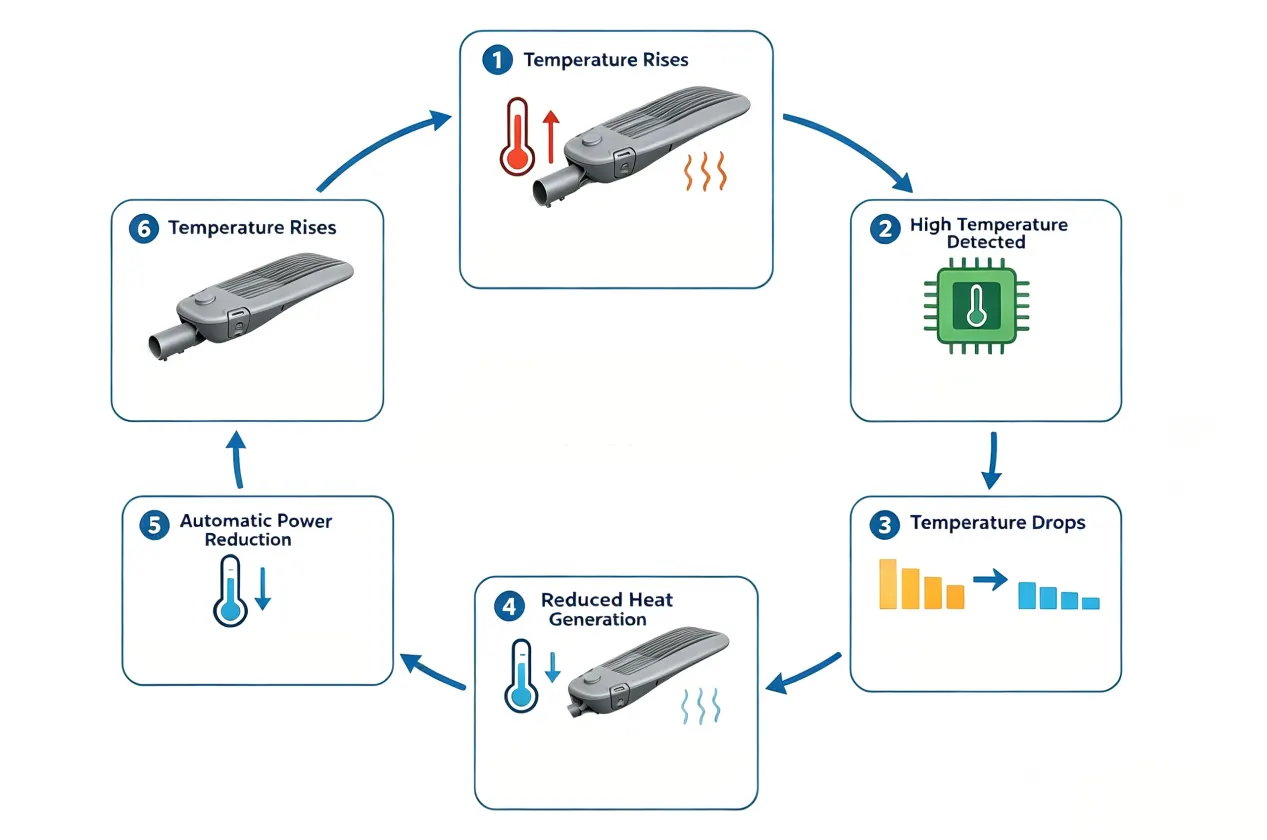
LED driver thermal protection mainly works by monitoring the internal temperature in real time. When the temperature reaches a preset threshold, the driver actively reduces its output power to protect the internal components.
Temperature rises → High temperature detected → Automatic power reduction → Temperature decreases → Gradual recovery of normal operation
Based on temperature changes, thermal protection can generally be divided into the following stages:
1. Normal Operation: Monitoring Only
When the driver temperature is within the normal operating range, the temperature detection circuit only monitors the temperature, and the street light operates normally.
2. Temperature Rises: Power Reduction
When the temperature reaches the value set by the technician, the driver automatically reduces its power output to reduce heat generation. As the temperature decreases, the driver gradually returns to normal operation.
3. Temperature Exceeds the Set Value: Automatic Shutdown / Stop Operation
When the temperature exceeds the preset value, the driver activates over-temperature protection and temporarily shuts down to stop output. Once the temperature drops back to a safe range, the driver automatically resumes operation.
The core principle of thermal protection is: when the temperature rises, reduce power to lower the temperature; if the temperature continues to rise, shut down to protect the driver. This reduces the damage caused by prolonged high-temperature operation, improving the stability and service life of LED street lights.
What Temperature Is Considered Normal for an LED Street Light Driver?
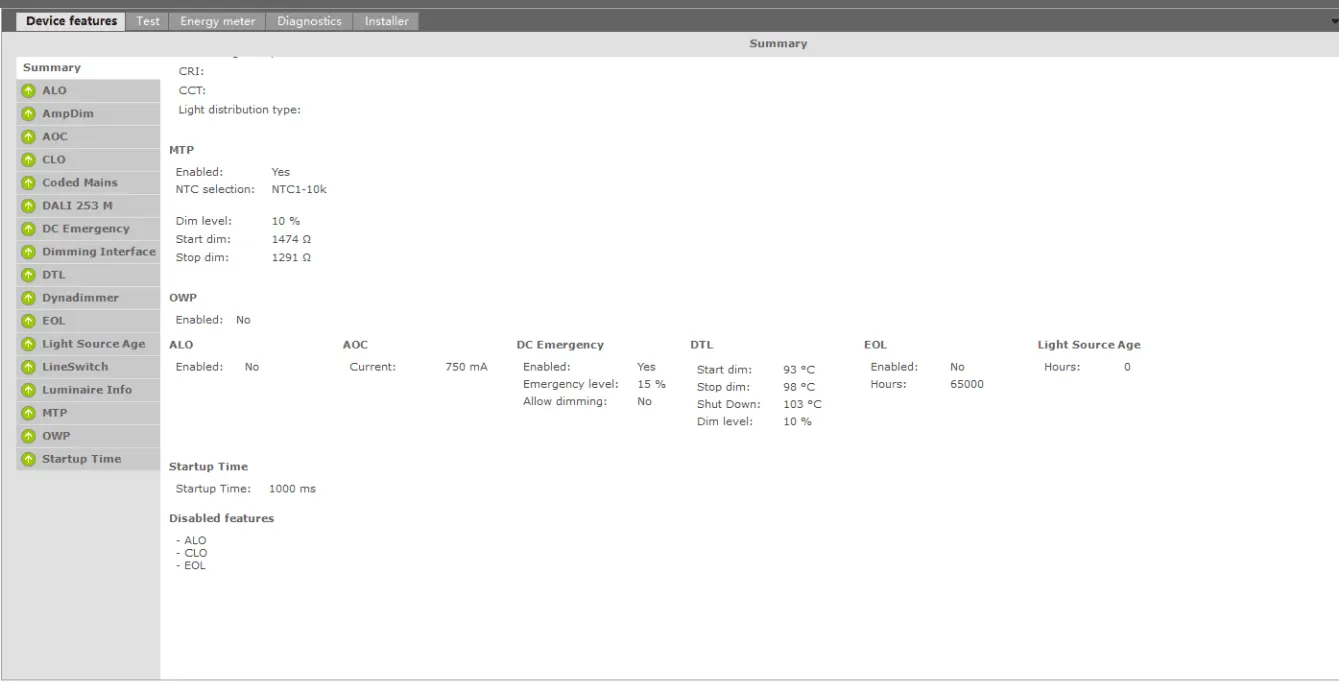
Take our customer in Israel as an example. The customer set the following thermal protection parameters for the light fixture:
When the operating temperature rises to 93°C, thermal control is activated and the driver gradually reduces the power output.
If the ambient temperature remains high and the temperature rises to 98°C, the driver further reduces the power output, with the minimum output locked at 10%.
If heat dissipation fails and the temperature rises to 103°C, the driver directly cuts off the output to prevent the LED chips from being damaged by excessive heat.
When the heat dissipation condition improves and the temperature drops below 93°C, the driver automatically restores normal output power, completing the thermal control cycle.
What Are the Effects of LED Street Light Overheating?
Long-term exposure to high temperatures accelerates the aging and damage of components, which may cause LED street lights to flicker, experience reduced brightness, or shut down intermittently.
Will an LED Driver Never Fail If It Has Over-Temperature Protection?
No. Thermal protection is a safety measure and cannot replace proper heat dissipation design. If heat dissipation is inadequate, , which can still accelerate component aging.