Could an Unverified LED Street Light Factory Put Your Business and Projects at Risk?
Choosing the wrong LED street light Manufacturer can create problems long after the purchase order is signed. A Supplier may offer attractive prices but provide limited production evidence, inconsistent quality control, or unclear testing procedures. These weaknesses can lead to shipment delays, product failures, warranty disputes, and damaged relationships with municipal or infrastructure customers. For every Wholesaler and regional distributor, the solution is a structured factory audit. By checking production capacity, QC procedures, testing capability, and traceability records, buyers can make sourcing decisions based on evidence rather than promises.
A reliable LED street light factory should demonstrate real production capability, documented incoming and final quality control, relevant photometric and environmental testing support, and traceability procedures for quality issues. Luxific provides outdoor lighting manufacturing, engineering, OEM and ODM capabilities, with quality control and certification support that buyers can review according to their project requirements.
Production Lines and Capacity Evidence
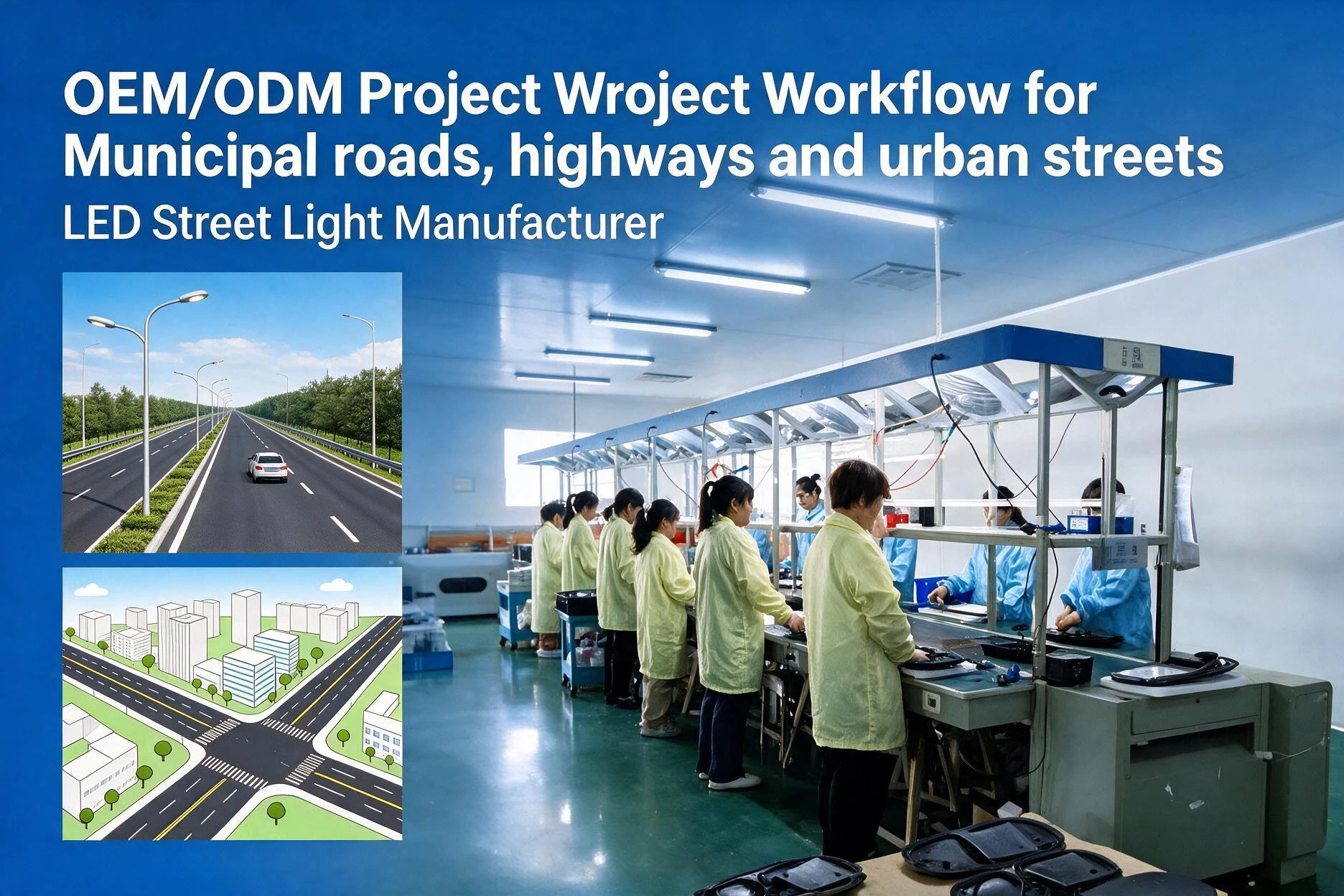
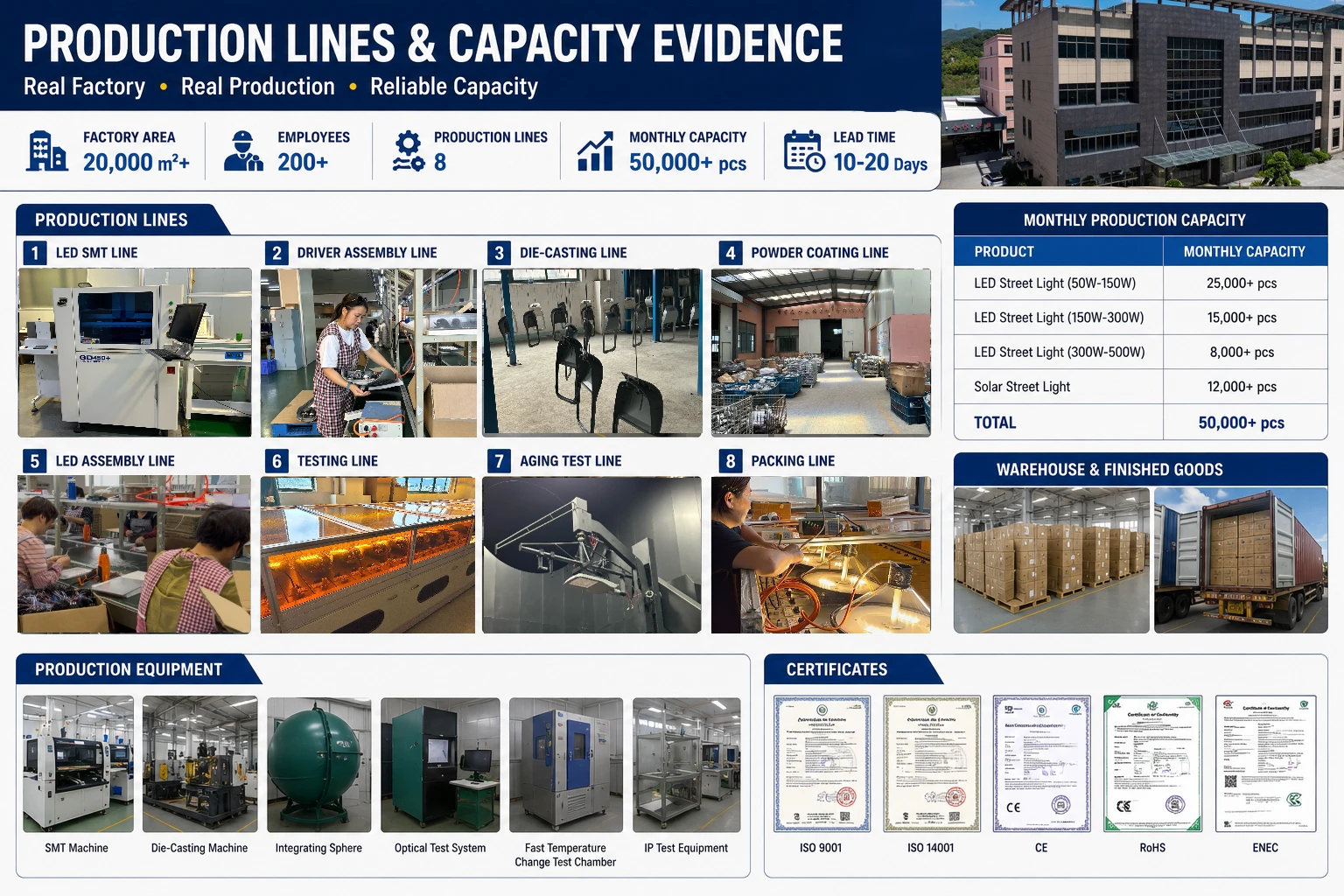
The first step in a factory audit is confirming that the Supplier has genuine manufacturing capability. Buyers should not evaluate capacity only by looking at a website, product catalog, or sales presentation. A professional Manufacturer should be able to explain how products move from materials and components through assembly, inspection, and final shipment.
What Importers Should Verify During a Factory Audit
- Number and organization of production lines
- Main production processes performed by the factory
- Assembly capability for LED street lights
- Production planning and scheduling procedures
- Capacity to support repeat orders
- Quality inspection points within production
- Warehouse and finished-product management
- Engineering resources supporting Customizable products
Luxific operates as an outdoor LED lighting Manufacturer with production capability for LED street lights and other outdoor lighting products. The company information emphasizes production facilities, engineering support, strict quality control, and the ability to support project-oriented OEM and ODM requirements.
Capacity Should Be Evaluated Against Your Actual Business Needs
A factory does not need to be the largest Supplier in the market to be suitable for your business. The important question is whether its production organization matches your purchasing volume, product complexity, and delivery requirements.
| Audit Item | What Buyers Should Check | Why It Matters |
|---|---|---|
| Production lines | Actual manufacturing and assembly workflow | Confirms operational capability |
| Production planning | How orders are scheduled and monitored | Supports delivery planning |
| Engineering support | Ability to respond to technical changes | Important for OEM and ODM projects |
| Quality stations | Inspection points during production | Helps control consistency |
| Repeat-order capability | Ability to reproduce approved specifications | Important for distributors |
Questions to Ask About Production Evidence
- Which processes are completed inside the factory?
- How are production orders scheduled?
- How does the Manufacturer handle peak production periods?
- Who approves technical changes?
- How are approved product specifications maintained for repeat orders?
- Can the Supplier explain its quality checkpoints?
Incoming, In-Process and Final QC
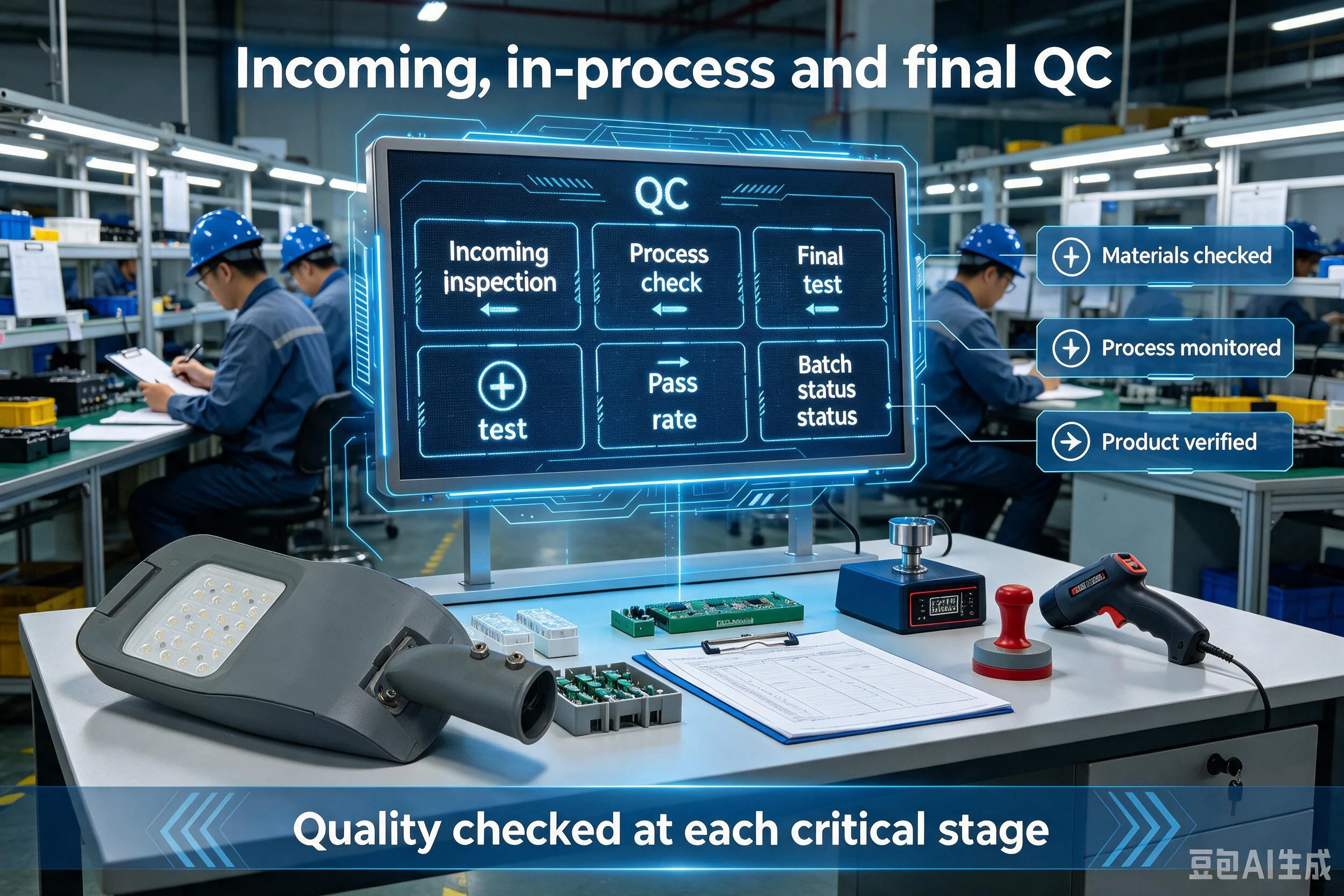
A factory audit should follow the product through the complete manufacturing journey. Quality problems are easier and less expensive to control when they are identified early rather than after the finished LED street lights have been shipped overseas.
Incoming Quality Control
Incoming QC focuses on materials and components before they enter production. Depending on the product specification, buyers should ask how the factory manages important components and whether incoming materials are checked against approved requirements.
- LED and electrical component identification
- Housing and mechanical component inspection
- Component specification verification
- Supplier documentation where applicable
- Storage and material identification procedures
In-Process Quality Control
In-process QC helps identify assembly or manufacturing problems before final packaging. During an audit, buyers should ask where inspections occur and what happens when a product does not meet the required specification.
Luxific presents strict quality testing and production control as part of its manufacturing and project support process. For major orders, importers should discuss the specific inspection requirements that apply to the selected LED street light model.
Final Quality Control
Final QC is the last opportunity to confirm that finished products match the approved specification before shipment.
- Confirm the approved product specification.
- Verify the finished product against key requirements.
- Check product identification and packaging.
- Confirm relevant functional or safety checks.
- Record inspection results according to the agreed procedure.
- Release approved products for shipment.
A Practical Buyer Rule
Do not simply ask whether a factory has QC. Ask where QC happens, who performs it, what is recorded, and how non-conforming products are handled.
Photometric and Environmental Test Equipment
LED street lights are designed for real outdoor environments, so a factory audit should also examine how product performance is evaluated. Importers serving municipalities, contractors, and infrastructure projects often need evidence related to lighting performance, durability, and environmental suitability.
Photometric Evaluation
Photometric information is important because a street lighting project requires more than high lumen output. Buyers need to understand whether the optical distribution is appropriate for the road, pole arrangement, and lighting objective.
Luxific street lighting information includes multiple optical distribution options for different applications, helping buyers consider factors such as light coverage, uniformity, and glare control. For project-based orders, buyers can discuss photometric requirements and available technical documentation with the engineering team.
Environmental Performance Questions
- What ingress protection rating is specified?
- What impact resistance rating applies to the product?
- What ambient operating conditions are specified?
- How is thermal performance considered?
- What surge protection configuration is available?
- Which environmental or reliability tests are relevant to the model?
For example, Luxific product information for selected outdoor lighting models includes specifications such as IP protection, IK ratings, operating temperature ranges, and surge protection options. Buyers should always verify the specifications of the exact model and configuration being purchased.
| Testing Area | Buyer Audit Focus | Commercial Importance |
|---|---|---|
| Photometric performance | Light distribution and project suitability | Supports proper road lighting design |
| Environmental protection | IP and weather resistance requirements | Supports outdoor durability |
| Mechanical protection | Impact resistance and housing design | Reduces installation and environmental risks |
| Electrical protection | Relevant electrical and surge requirements | Supports system reliability |
| Certification support | Documents relevant to destination markets | Helps reduce compliance risks |
Traceability and Corrective-Action Records
Traceability is one of the most important but frequently overlooked areas of a factory audit. When a problem occurs after shipment, the buyer needs a clear process for identifying the affected product, investigating the cause, and preventing the same issue from happening again.
What Good Traceability Should Help a Factory Do
- Identify the relevant production batch or order
- Connect products with approved specifications
- Review available inspection information
- Identify the source of a reported quality issue
- Support communication between the Manufacturer and customer
- Provide a basis for corrective action
Questions to Ask About Corrective Actions
- How is a customer quality complaint recorded?
- Who investigates the issue?
- How is the root cause evaluated?
- What corrective action is taken?
- How is the effectiveness of the corrective action reviewed?
- How are similar problems prevented in future production?
A reliable Supplier should not treat every quality issue as an isolated event. The goal of corrective action is to understand the cause and improve the process. This is especially important for Wholesalers and regional distributors that depend on consistent product performance across repeat orders.
OEM and ODM Projects Require Additional Audit Attention
When purchasing Customizable LED street lights, factory auditing should go beyond standard production. OEM and ODM projects may involve changes to appearance, dimensions, materials, colors, branding, packaging, or technical configurations.
Luxific offers OEM and ODM customization for project requirements, including product appearance, materials, dimensions, colors, logos, and packaging. Buyers should clarify which requirements can be implemented, how technical changes are approved, and how the final specification is controlled before mass production.
OEM and ODM Audit Checklist
- Confirm the approved technical specification.
- Clarify the customization scope.
- Identify engineering responsibility.
- Approve samples when necessary.
- Confirm branding and packaging requirements.
- Document changes before mass production.
- Agree on inspection requirements for the final product.
How to Score an LED Street Light Factory Audit
A practical audit does not require complicated paperwork. Buyers can score each major area according to the importance of their market and project requirements.
- Production capability and capacity evidence
- Incoming material control
- In-process quality control
- Final inspection procedures
- Photometric and environmental testing support
- Certification and documentation control
- Traceability procedures
- Corrective-action response
- OEM and ODM engineering capability
- Communication and delivery management
The best Manufacturer is not necessarily the one making the biggest promises. For professional importers, the stronger choice is usually the Supplier that can provide clear evidence, communicate limitations honestly, and maintain a repeatable process for quality and project support.
Start Your LED Street Light Sourcing Review
Send Luxific your road dimensions, pole height, target illuminance, quantity, required market certifications, and delivery deadline. Our team can help review suitable LED street light options, discuss OEM or ODM requirements, and prepare a project-oriented selection and quotation.