A roadway lighting specification can fail long before installation if fixture details are incomplete. A weak housing, unsuitable driver, insufficient surge protection, or missing test documentation can create maintenance costs, tender delays, and compliance risks. For DOTs, municipalities, and EPC contractors, the real concern is not simply buying a low-cost luminaire. It is selecting a reliable fixture that meets project requirements, performs in harsh environments, and remains serviceable throughout its operating life.
The best roadway lighting specification should verify housing and thermal design, tool-free serviceability, driver and surge protection, dimming compatibility, IP/IK ratings, corrosion resistance, operating temperature, photometric performance, and complete LM-79/TM-21 and certification documentation. Luxific supports these requirements with customizable LED roadway fixtures, OEM and ODM capabilities, testing documentation, and international certifications.

1. Housing, Thermal Design and Tool-Free Serviceability
For roadway projects, the luminaire housing is more than an enclosure. It affects heat dissipation, mechanical durability, maintenance access, and long-term reliability. A DOT or municipal specification should therefore evaluate the complete mechanical design rather than focusing only on LED wattage or lumen output.
Housing checklist
- Confirm housing material, such as die-cast aluminum, and corrosion-resistant surface treatment.
- Check whether the optical and electrical compartments are appropriately protected.
- Review wind-load considerations, especially for exposed roads and bridges.
- Verify lens and diffuser materials for outdoor durability.
- Confirm mounting dimensions and compatibility with existing poles or brackets.
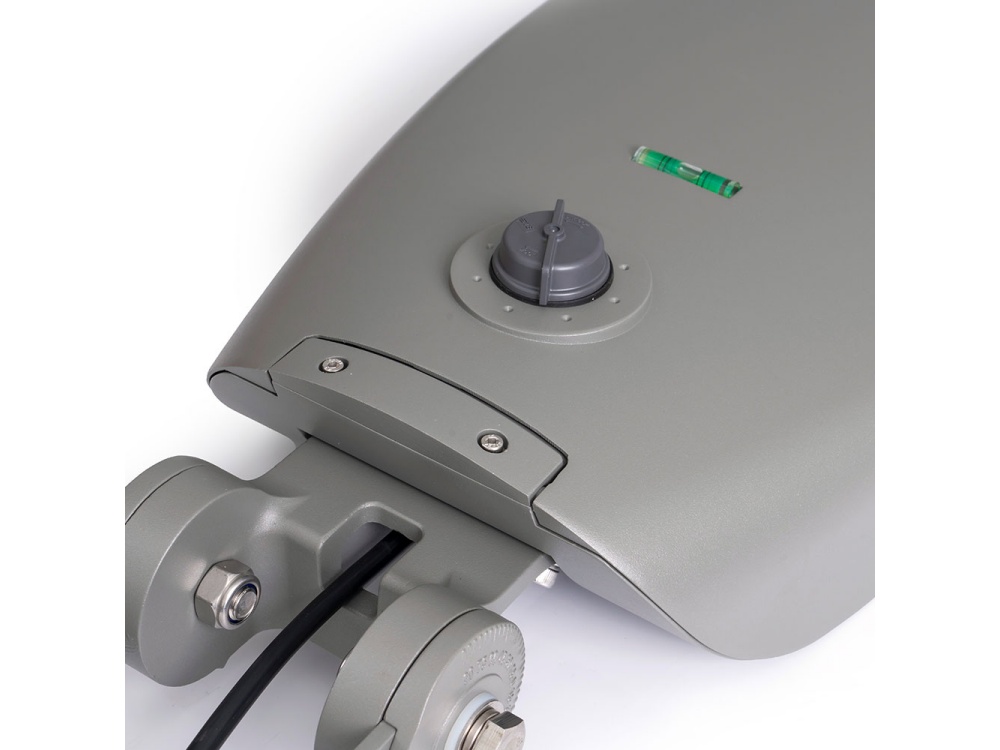
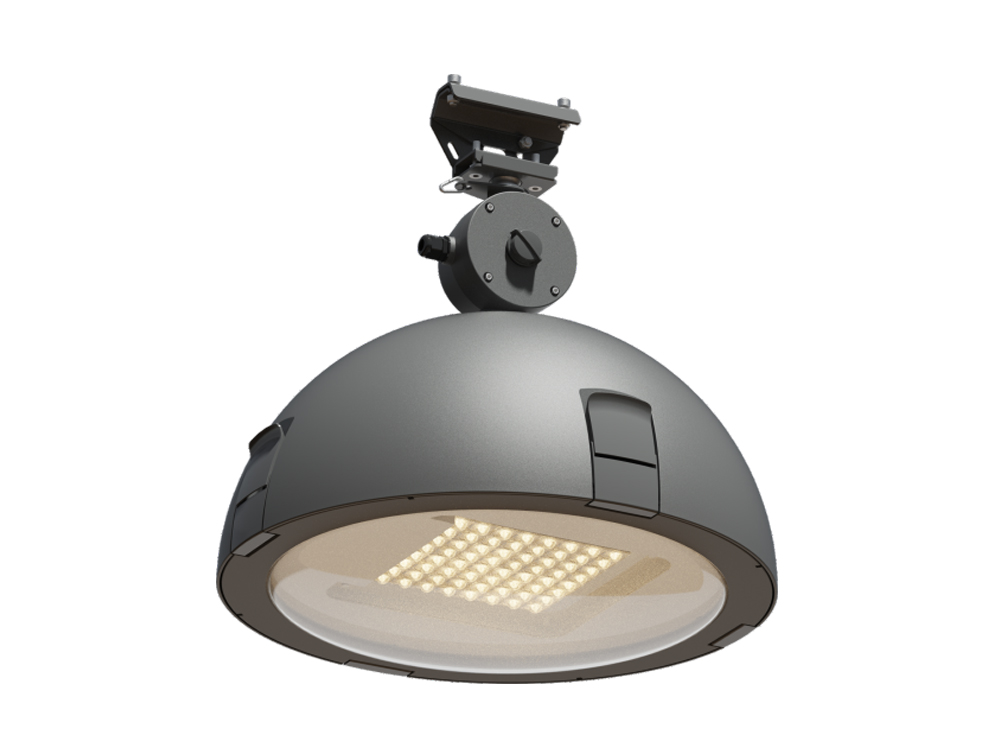
Luxific roadway fixtures use die-cast aluminum housings, anodized aluminum reflectors and PC or PMMA optical components. Selected models also use UV-resistant coating and integrated cooling fins. The VEGA series provides tool-free opening and modular construction, supporting installation, maintenance, and future upgrades.
Thermal management matters
LED performance is strongly influenced by temperature. Poor heat dissipation can accelerate component degradation and reduce stability. A specification should therefore request information about thermal construction and the intended ambient operating range rather than relying only on a claimed LED lifetime.
| Specification item | Luxific example | Why it matters |
|---|---|---|
| Housing | Die-cast aluminum | Supports mechanical strength and heat dissipation |
| Ambient temperature | -40°C to +55°C on selected roadway models | Important for extreme climates |
| Service access | Tool-free opening on VEGA series | Can simplify maintenance procedures |
| Optical system | Anodized aluminum reflector with PC/PMMA diffuser | Supports controlled light distribution |
2. Driver, Surge and Dimming Requirements
The LED driver should be treated as a critical specification item, not an interchangeable accessory. Driver failure can result in flickering, partial output, or complete luminaire failure. For municipal and EPC tenders, specify the electrical operating range, control interface, power factor requirements, and surge protection before comparing supplier prices.
Driver and electrical checklist
- Define input voltage and frequency according to the project power network.
- Specify acceptable driver performance and compatibility with the LED system.
- Confirm power factor requirements where applicable.
- Specify surge protection according to the project environment and local tender requirements.
- Identify whether dimming is required at commissioning or for future smart-city integration.
Luxific roadway models can provide DALI, 0-10V, Astro Dim, and Step Dim control inputs. Selected fixtures also support photocell, NEMA socket, and Zhaga options. One documented roadway model provides 10KV, 10KA surge protection and a power factor of at least 0.95.
Dimming and smart controls
Dimming should be specified according to the intended operating strategy. For example, municipalities may require different light levels during periods of lower traffic. The specification should clearly state the control protocol, dimming range, compatibility requirements, and whether future smart controls are expected.
- Define the required control method.
- Confirm driver compatibility before tender approval.
- Check whether photocell, NEMA, or Zhaga interfaces are required.
- Request a complete control wiring and configuration description.
- Validate the proposed system through sample testing or project photometric review.
3. IP/IK, Corrosion and Operating Temperature

Roadway fixtures operate continuously in rain, dust, temperature changes, vibration, and other environmental conditions. A specification that lists only wattage and lumens is incomplete. IP and IK ratings should be considered together with housing construction, coating, materials, and the actual project environment.
Protection and environmental checklist
- Specify the minimum IP rating required for the installation.
- Specify IK impact resistance where vandalism, debris, or harsh handling is a concern.
- Review corrosion protection for coastal, industrial, or high-humidity locations.
- Confirm the operating temperature range against the actual project climate.
- Consider vibration, snow, ice, salt exposure, and other site-specific conditions.
Luxific roadway models include IP66 and IK09 configurations. For demanding applications, Luxific also documents products designed for harsh environments. A Canadian mining project required operation at temperatures as low as -40°C, and the supplied solution used cold-weather-rated drivers and components, a die-cast aluminum housing, and IK10 impact resistance.
| Project condition | Specification focus | Supplier documentation to request |
|---|---|---|
| Urban roadway | IP rating, optical distribution, maintenance access | Datasheet and photometric files |
| Highway | Uniformity, glare control, surge protection | Photometric and electrical documentation |
| Coastal or industrial area | Corrosion resistance and environmental durability | Material and environmental test information |
| Cold climate | Driver and fixture operating temperature | Temperature and testing documentation |
4. LM-79, TM-21 and Tender Documentation
For DOT, municipal, and EPC procurement, technical documentation is part of the product. A competitive Manufacturer or Supplier should be able to provide consistent documentation that allows engineers and purchasing teams to verify whether the proposed fixture actually meets the specification.
Documentation checklist
- Product datasheet with electrical, optical, mechanical, and environmental parameters.
- Photometric information suitable for roadway lighting calculations.
- Relevant LM-79 and TM-21 documentation where required by the tender.
- Applicable certifications and testing reports.
- Driver and surge protection information.
- IP and IK ratings.
- Operating temperature range.
- Warranty and after-sales support information.
- Installation and maintenance instructions.
Luxific documentation lists CE, CB, ENEC, EMC, TM21, LM79, and IEC-62471 for selected roadway products. The company also states that its broader certification portfolio includes ISO 9001, CE, RoHS, and CB. However, tender requirements differ by country and project, so each certificate should be checked against the exact fixture model and specification before submission.
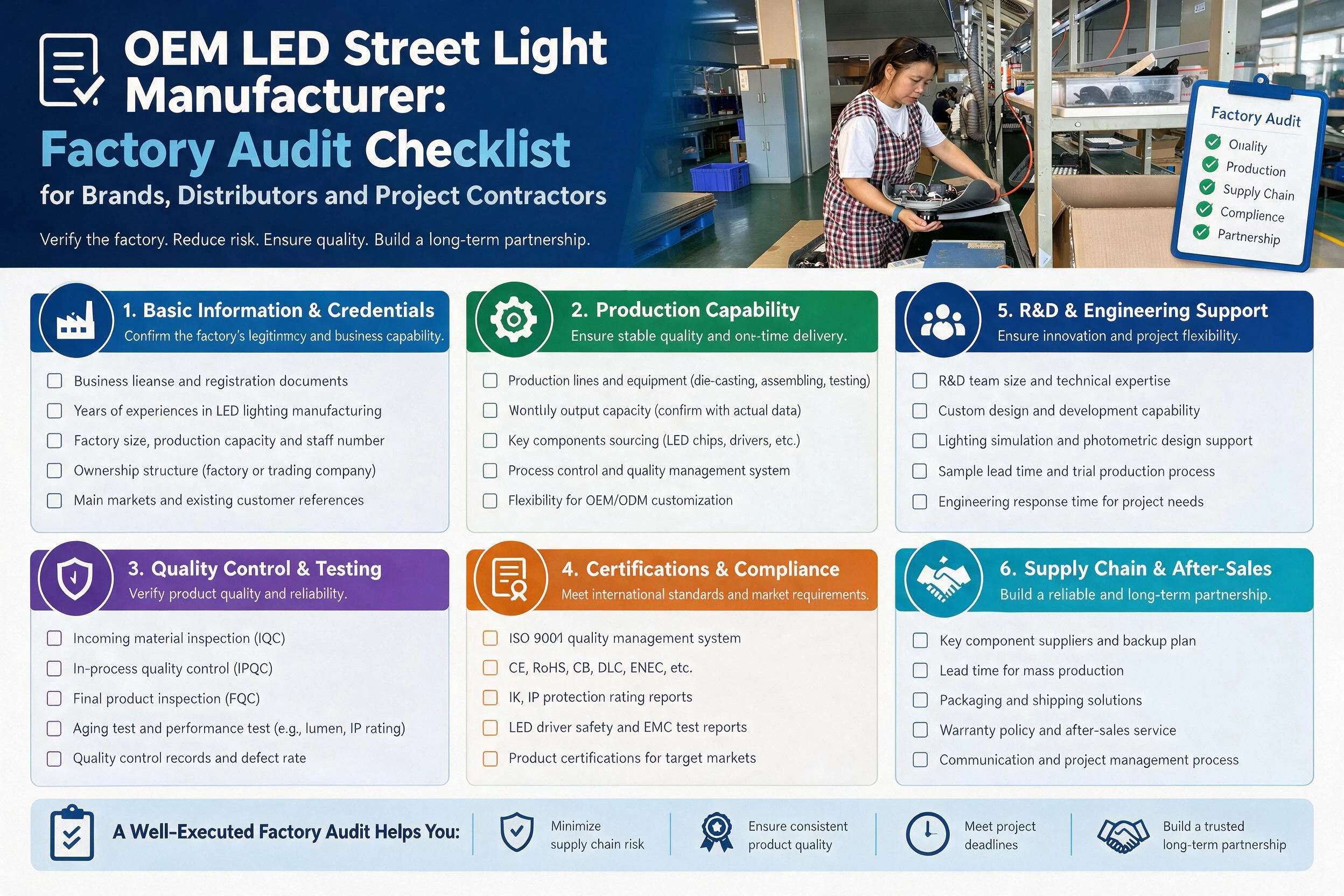
How to evaluate a roadway lighting Supplier
- Start with the project specification rather than the supplier catalogue.
- Match road width, pole height, spacing, target illuminance, and distribution requirements.
- Verify electrical and environmental parameters against the tender.
- Request test reports and certificates for the exact proposed model.
- Review samples or prototypes when the project is technically sensitive.
- Compare total lifecycle considerations, including energy use, maintenance, warranty, and replacement requirements.
For wholesalers, Luxific can also support OEM and ODM projects. Its documented customization services include appearance, materials, dimensions, colors, logos, packaging, and project-oriented product design. This can be useful when an EPC contractor or Wholesaler needs a fixture adapted to a specific project or brand strategy.
Final Roadway Fixture Checklist
- Housing and thermal design verified
- Tool-free maintenance requirements confirmed
- Driver and input voltage specified
- Surge protection defined
- Dimming and smart-control interfaces confirmed
- IP and IK ratings verified
- Corrosion protection matched to the environment
- Operating temperature confirmed
- Photometric performance documented
- LM-79 and TM-21 documentation checked where required
- Certificates and reports matched to the actual model
- Warranty, logistics, and technical support reviewed
Conclusion
Send Luxific your road dimensions, pole height, target illuminance, quantity, required market certifications, and delivery schedule. Our engineering team can then recommend a suitable roadway lighting configuration and prepare a project-oriented quotation for your DOT, municipal, EPC, OEM, or ODM requirements.