Why Roadway Lighting Failures Can Become Expensive Infrastructure Problems
Roadway lighting failures rarely begin with a single defective component. Glare can reduce visual comfort, poor optical selection can create dark spots, and inadequate protection can expose drivers and electronics to surges, moisture, or excessive heat. For municipalities, EPC contractors, infrastructure companies, and lighting Wholesalers, these problems can mean complaints, maintenance costs, redesign work, and project delays. The solution is prevention: define the road requirements clearly, validate the photometric design, specify environmental protection, and commission the installation before the project is handed over.
Prevent roadway lighting failures by controlling glare, maintaining uniform illumination, protecting against surge and water ingress, managing heat, and validating specifications through photometric design and commissioning. Luxific provides Customizable roadway lighting with OEM and ODM support for infrastructure and wholesale projects.
1. Glare and Over-Lighting
More light does not automatically mean better roadway lighting. Excessive brightness, poorly controlled distribution, or incorrect mounting angles can create glare while increasing energy consumption without improving the visual environment for drivers.
Common Causes of Glare
- Incorrect optical distribution for the road geometry
- Excessive luminaire tilt
- Insufficient control of high-angle light
- Incorrect mounting height or setback
- Using excessive lumen output to compensate for poor optical design
- Replacing an existing fixture without recalculating the new photometric performance
How to Prevent Over-Lighting
The correct approach is to start with the required illuminance or luminance and uniformity, then select the appropriate LED output and optical distribution. A Manufacturer or Supplier should evaluate the complete installation rather than recommending a fixture based only on wattage or lumen output.
- Record road width and lane configuration.
- Record pole height, spacing, setback, and mounting angle.
- Define the required lighting level and uniformity.
- Select an appropriate optical distribution.
- Validate the design with the relevant photometric file.
- Review glare and unnecessary light spill before installation.
Buyer Checkpoint
When comparing suppliers, ask for the recommended mounting height, spacing, optical distribution, and photometric data for your actual road conditions. This provides more useful information than comparing fixture wattage alone.
2. Dark Spots and Poor Uniformity
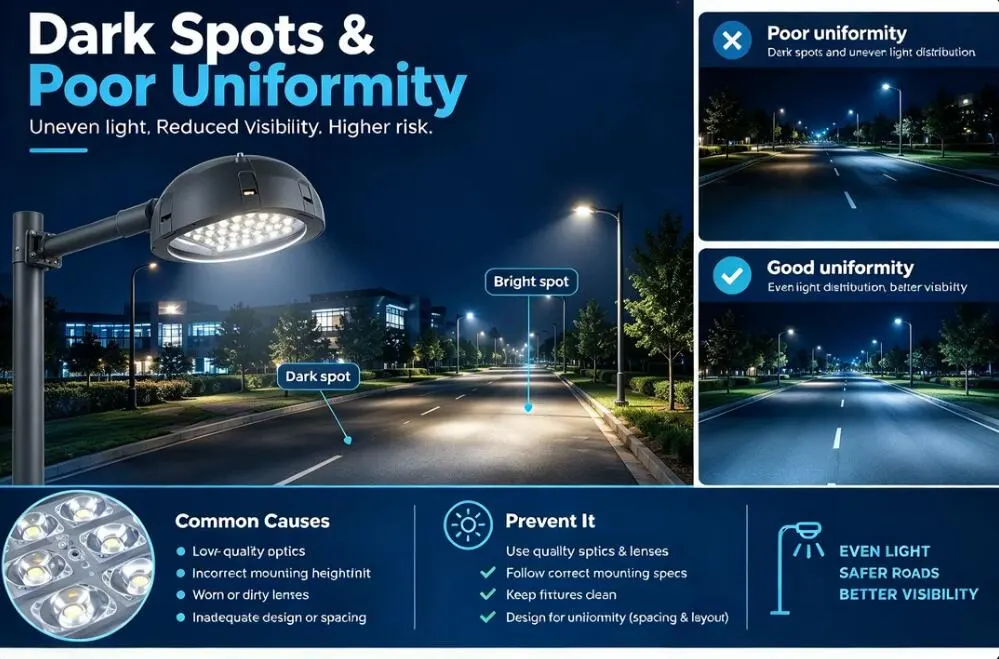
Dark areas between poles are one of the most noticeable roadway lighting problems. They can occur when pole spacing is too large, the optical distribution is unsuitable, or the luminaire is installed at a different angle from the design calculation.
Typical Causes
| Failure | Possible Cause | Prevention |
|---|---|---|
| Dark areas between poles | Excessive spacing or unsuitable optics | Validate spacing with photometric calculations |
| Road edge is too dark | Incorrect lateral distribution | Match optics to road width and setback |
| Uneven brightness | Incorrect mounting height or output | Check uniformity during design |
| Light concentrated in the wrong area | Incorrect tilt or optical selection | Confirm mounting angle before installation |
| Performance differs from design | Installation does not match calculation | Use commissioning and field verification |
Design for the Complete Roadway
A roadway luminaire should illuminate the required area consistently rather than simply producing a high peak value directly below the pole. Pole height, spacing, road width, mounting arrangement, optical distribution, and fixture output must be considered as one system.
Luxific focuses its roadway lighting solutions on uniform light distribution and flexible designs for different road applications. Its product portfolio includes LED street lights, highway lights, tunnel lights, bridge lights, and smart street lights, allowing the product configuration to be considered according to the application.
Commissioning Uniformity
After installation, the contractor should confirm that the actual pole spacing, mounting height, luminaire orientation, and tilt correspond to the approved design. Where the project specification requires field measurements, these should be completed before final handover.
- Verify pole spacing.
- Verify mounting height.
- Check luminaire orientation.
- Check tilt angle.
- Confirm the installed model and optical configuration.
- Complete required field lighting measurements.
3. Surge, Water Ingress and Overheating
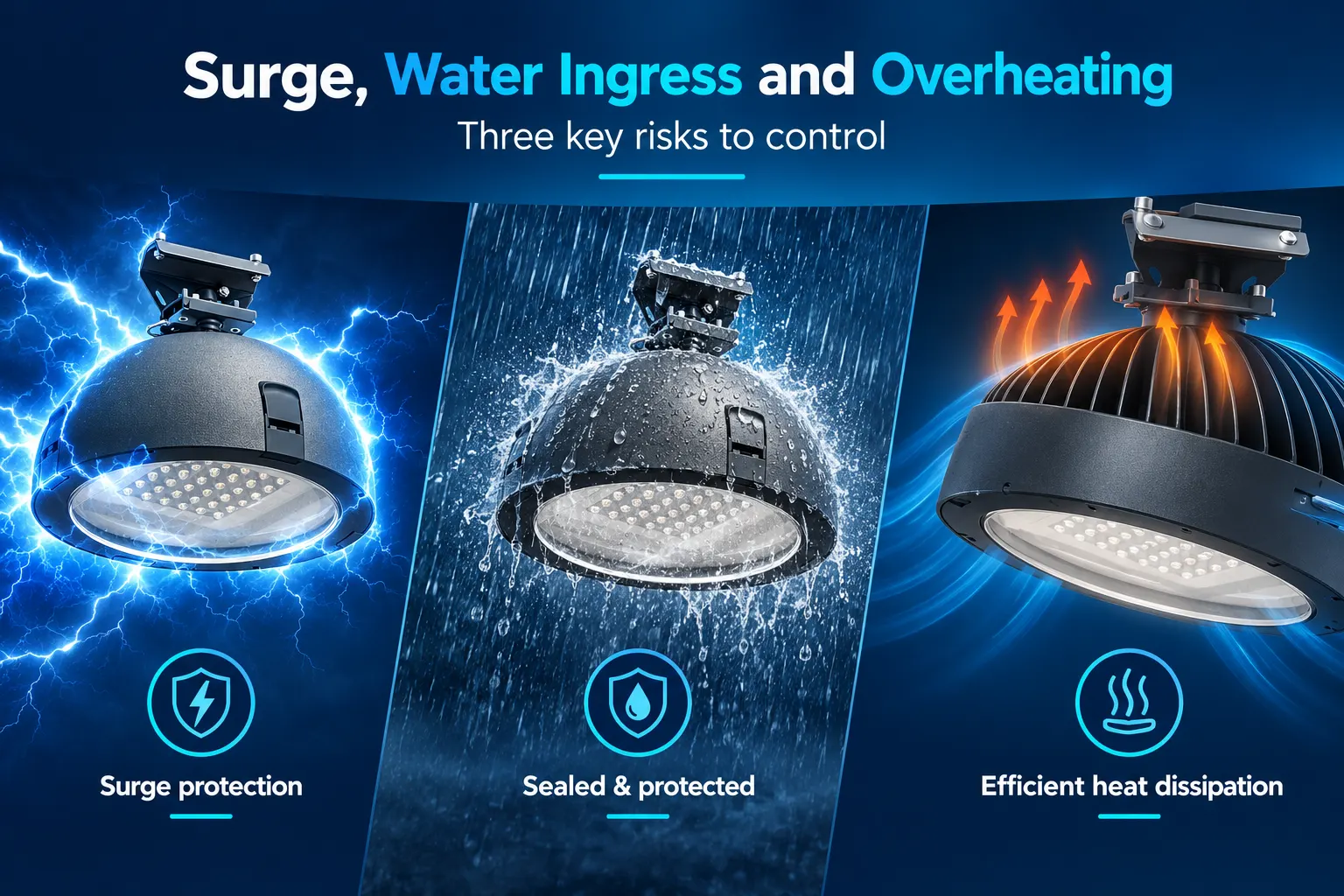
Outdoor roadway luminaires operate in an environment where electrical surges, rain, dust, temperature changes, and long operating hours can place stress on electronic components. Prevention starts with specifying the correct protection level for the actual project environment.
Surge Protection
Roadside electrical systems can experience transient voltage events. The required surge protection should therefore be defined during specification rather than treated as an optional detail after the product has been selected.
- Define the required surge protection level.
- Confirm the driver specification.
- Check compatibility with the local electrical system.
- Consider the electrical characteristics of the existing infrastructure in retrofit projects.
- Request relevant testing or technical documentation.
Water Ingress
Water ingress can damage drivers, connectors, and other electrical components. The appropriate IP protection should be selected according to the installation environment and project requirements.
For coastal, humid, industrial, or exposed locations, buyers should also consider corrosion resistance and the condition of the luminaire housing, seals, connectors, and mounting components.
Overheating
LED performance and electronic reliability are influenced by thermal conditions. A roadway specification should therefore identify the expected ambient temperature and require the selected luminaire to be suitable for that environment.
| Environmental Risk | Specification Focus | Buyer Action |
|---|---|---|
| Electrical surges | Driver and surge protection | Define required protection level |
| Heavy rain or moisture | IP protection and sealing | Match rating to installation conditions |
| Roadside impact exposure | IK protection | Confirm project requirement |
| High ambient temperature | Thermal management and operating range | Check specified temperature limits |
| Coastal environment | Corrosion resistance | Specify suitable materials and surface treatment |
Do Not Use One Protection Specification for Every Project
A motorway in a dry inland environment may have different environmental requirements from a coastal road, port access road, or industrial area. The Supplier should therefore receive the project location and environmental conditions before final product selection.
4. Prevent Failures Through Better Specifications
Many installation problems can be reduced before production begins. A clear technical specification gives the Manufacturer and project team the same reference point and reduces the risk of misunderstandings.
Specification Checklist
- Road classification and application
- Road width and number of lanes
- Pole height and spacing
- Mounting arrangement and setback
- Target illuminance or luminance
- Required uniformity
- Optical distribution
- Luminaire power and lumen output
- Driver requirements
- Surge protection
- IP and IK requirements
- Operating temperature
- Corrosion protection
- Dimming and control requirements
- Photometric files
- Required market certifications
- Warranty and maintenance requirements
- Delivery schedule
Why Photometric Files Matter
IES or LDT photometric files allow the proposed luminaire to be evaluated within the actual road geometry. This helps identify potential dark areas, excessive brightness, and unsuitable optical distribution before the products are installed.
- Obtain the correct photometric file for the proposed configuration.
- Input the actual pole and roadway dimensions.
- Calculate the required lighting performance.
- Review uniformity and critical areas.
- Adjust optics, power, spacing, or mounting conditions where necessary.
- Approve the final configuration before mass production.
Commissioning Before Handover
Commissioning closes the gap between the approved design and the installed system. It should confirm that the delivered product and installation match the approved specification.
- Check product model and quantity.
- Check optical configuration.
- Confirm mounting height and angle.
- Confirm pole spacing.
- Check electrical connections and controls.
- Verify the required lighting performance.
- Record any deviations for corrective action.
5. Work With a Manufacturer That Can Support Prevention
For infrastructure projects, preventing failure is not only a product issue. Communication, documentation, production control, technical support, and delivery coordination also affect project risk.
Luxific is a B2B LED lighting Manufacturer and Supplier with five production lines and a product portfolio covering roadway, area, flood, high mast, landscape, decorative, sports, and solar lighting. Its road lighting range includes LED street lights, solar street lights, smart street lights, highway lights, tunnel lights, and bridge lights.
For project-specific requirements, Luxific supports Customizable solutions as well as OEM and ODM cooperation. This can help buyers address different road geometries, product configurations, branding requirements, and market needs without relying on a standard fixture for every application.
Questions to Ask Before Ordering
- Can you provide the photometric file for the exact proposed configuration?
- Can you recommend optics based on our pole height and spacing?
- What protection and operating-temperature specifications apply?
- What documentation is available for our target market?
- Can the product be customized for our project requirements?
- What quality-control and delivery process will support the project?
Conclusion
Prevent roadway lighting failures before production and installation. Send Luxific your road dimensions, pole height, target illuminance, quantity, required market certifications, and delivery date. Our team can review the application, recommend a suitable configuration, and prepare a project quotation.