Why Poor Retrofit Planning Can Turn Energy Savings Into Project Risk
Replacing aging HPS or MH roadway lighting with LED fixtures can reduce energy use and maintenance demand, but a simple one-for-one wattage swap may create poor light distribution, glare, dark areas, or compatibility problems. Existing poles, brackets, electrical supplies, mounting angles, and spacing all affect the final result. For municipalities, EPC contractors, infrastructure companies, and lighting Wholesalers, an incomplete retrofit assessment can lead to redesign costs, installation delays, and disappointing project performance. A successful retrofit starts with an audit, then uses photometric evidence to select the new LED configuration.
A reliable LED roadway retrofit should audit existing poles and electrical supply, replace HPS or MH based on photometric performance rather than watts, verify bracket and optical compatibility, and calculate energy, maintenance, and payback results. Luxific provides Customizable LED roadway lighting with OEM and ODM support for retrofit projects.
1. Audit Existing Poles and Electrical Supply Before Replacement

The first retrofit question is not which LED fixture to buy. It is whether the existing infrastructure can support the proposed LED system. A site audit provides the information needed to avoid unexpected modification costs during installation.
Check the Existing Pole Infrastructure
- Pole height and material
- Pole spacing and arrangement
- Roadside setback and mounting position
- Existing bracket dimensions and condition
- Luminaire mounting diameter and connection method
- Pole corrosion, mechanical damage, and structural condition
- Existing luminaire tilt and orientation
Review the Electrical Supply
Existing HPS and MH systems may have electrical components that are no longer required after an LED conversion. The retrofit specification should identify the existing voltage, circuit arrangement, switching method, control system, and condition of the electrical infrastructure.
| Audit Item | Information to Record | Why It Matters |
|---|---|---|
| Existing lamp | HPS, MH, wattage and quantity | Provides the starting point for comparison |
| Pole geometry | Height, spacing and setback | Influences optical selection |
| Mounting | Bracket size, angle and connection | Determines mechanical compatibility |
| Electrical system | Voltage, circuit and controls | Defines driver and control requirements |
| Road characteristics | Width, lanes and traffic conditions | Supports photometric evaluation |
Do Not Assume Existing Infrastructure Is Automatically Suitable
Keeping existing poles can reduce civil work, but the condition and geometry must still be verified. If pole spacing, height, bracket position, or structural condition is unsuitable for the new LED configuration, modification may be necessary before installation.
2. Replace HPS and MH by Photometrics, Not Watts
One of the most common retrofit mistakes is selecting an LED fixture simply because its wattage is lower than the existing HPS or MH lamp. Wattage indicates electrical consumption, not how effectively light is distributed across the roadway.
Compare Lighting Performance
A proper retrofit should compare the existing lighting condition with the proposed LED solution using measurable criteria such as illuminance, luminance where applicable, uniformity, glare, and light distribution.
- Existing lamp wattage and actual operating hours
- Proposed LED power consumption
- Delivered lumen output
- Roadway illuminance or luminance
- Overall and longitudinal uniformity where required
- Optical distribution
- Mounting height and spacing
- Expected maintained performance
Why Watt-for-Watt Replacement Is Not Enough
A 250 W HPS installation does not automatically require a specific LED wattage. The correct LED power depends on the luminaire efficiency, optical distribution, mounting geometry, road width, target lighting level, and required uniformity.
The same principle applies to MH systems. Instead of asking for a direct wattage equivalent, the buyer should provide the existing site conditions and required lighting criteria to the Manufacturer or Supplier.
Use Photometric Files to Validate the Retrofit
- Record the existing pole and road geometry.
- Identify the current lighting performance where measurement data is available.
- Select a preliminary LED luminaire and optical distribution.
- Obtain the corresponding IES or LDT photometric file.
- Run a calculation using the actual pole height and spacing.
- Check illuminance or luminance and uniformity against the project requirement.
- Adjust power, optics, mounting angle, or spacing when necessary.
Luxific provides roadway lighting designed for applications including streets, highways, tunnels, bridges, and other outdoor infrastructure. Its product range supports different roadway requirements, allowing project specifications to be considered rather than relying only on a simple lamp replacement approach.
3. Verify Bracket, Tilt and Optical Compatibility
Even when an LED roadway luminaire has suitable electrical performance, the retrofit can underperform if its mounting position or optical distribution does not match the existing infrastructure.
Bracket Compatibility
Before ordering, compare the existing bracket with the new luminaire mounting interface. Check mounting diameter, insertion depth, fixing method, available adjustment, and mechanical condition.
- Confirm pole-top or side-entry mounting compatibility.
- Check the required mounting diameter.
- Verify the available tilt adjustment.
- Confirm the bracket can support the new luminaire.
- Check cable routing and electrical connection access.
Tilt and Optical Distribution
Changing the luminaire tilt can significantly alter the location of the light on the roadway. A fixture that performs well in one mounting configuration may produce a different distribution after installation at another angle.
For this reason, the retrofit calculation should use the actual installation geometry. Optical selection should consider the road width, pole height, spacing, setback, and mounting arrangement together.
Retrofit Optical Checklist
- Roadway width
- Number of traffic lanes
- Pole height
- Pole spacing
- Pole setback
- Mounting angle
- Single-side, staggered, opposite-side, or median arrangement
- Required illuminance, luminance, and uniformity
- Required glare and spill-light control
Luxific offers flexible roadway lighting configurations and customization support. For project applications, OEM and ODM services can also be used where the luminaire, appearance, materials, dimensions, branding, or related requirements need to be adapted.
4. Verify Energy Savings, Maintenance and Payback
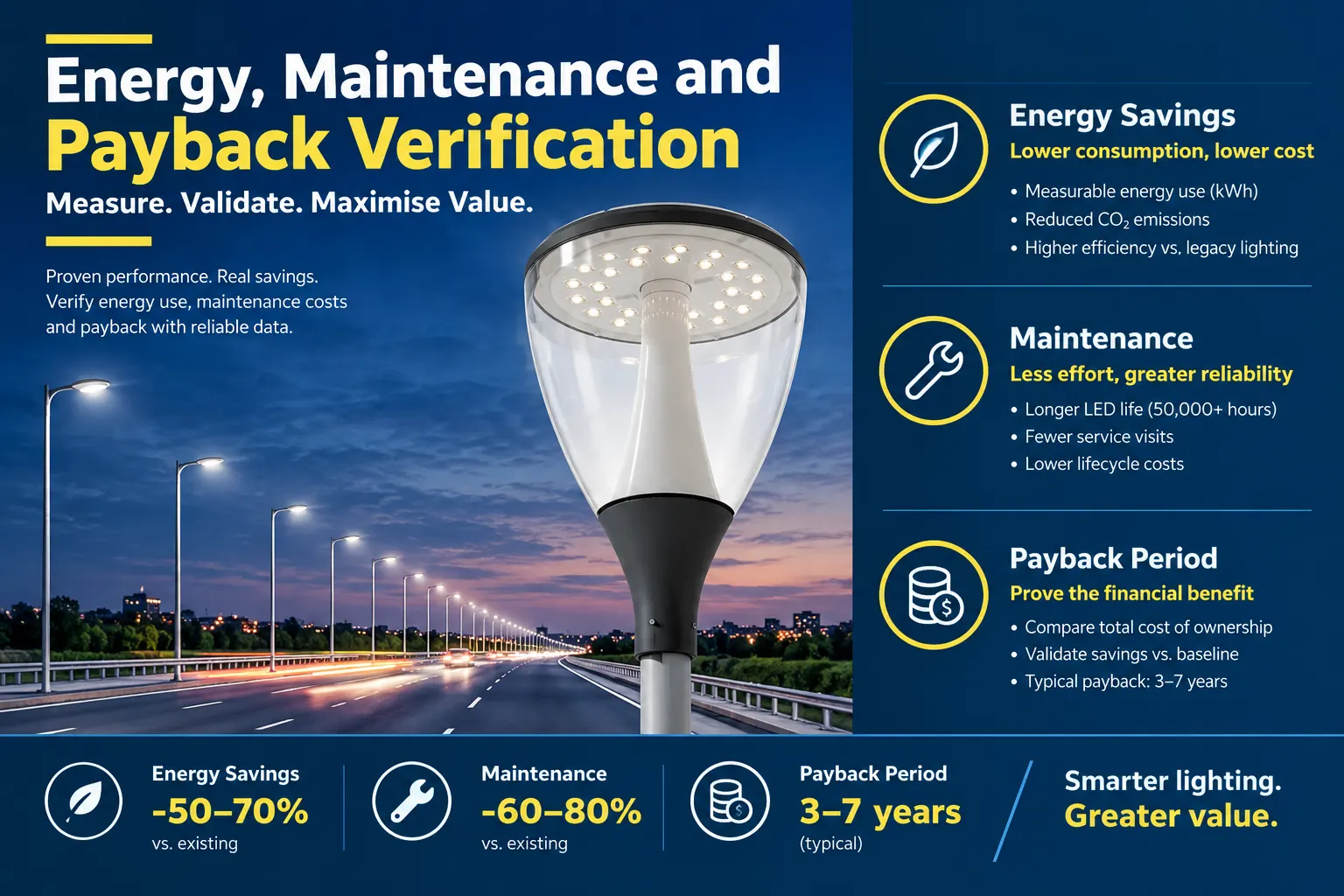
A roadway retrofit should be evaluated as a lifecycle investment rather than only as a fixture purchase. Energy consumption, operating hours, maintenance requirements, expected service life, replacement costs, and installation expenses all influence the final financial result.
Build a Simple Energy Comparison
| Cost Factor | Existing HPS or MH | Proposed LED |
|---|---|---|
| Connected lighting power | Record actual system power | Record proposed luminaire power |
| Annual operating hours | Use actual schedule | Use actual or proposed schedule |
| Energy consumption | Calculate annual usage | Calculate annual usage |
| Maintenance | Include lamp and ballast service | Include LED and driver maintenance assumptions |
| Control strategy | Existing operation | Include dimming where applicable |
Consider Maintenance Cost
LED retrofit economics should include more than electricity savings. Buyers should consider how often existing lamps require replacement, whether access equipment is needed, labor costs, traffic management, spare parts, and the expected maintenance requirements of the proposed LED system.
Luxific focuses its roadway lighting solutions on long service life, low maintenance cost, uniform light distribution, and flexible designs for different road applications. Its product range also includes solutions with tool-efficient maintenance features, supporting the practical needs of infrastructure operators.
Calculate Payback Using Real Project Data
- Calculate the existing annual electricity cost.
- Calculate the proposed LED electricity cost.
- Estimate annual energy savings.
- Add expected maintenance savings where reliable data is available.
- Include fixture, installation, electrical modification, and disposal costs.
- Calculate the simple payback period.
- Review the result against the expected project service period.
For municipalities and infrastructure contractors, the lowest purchase price is not always the same as the lowest lifetime cost. A retrofit specification should therefore balance product price, energy consumption, maintenance, reliability, documentation, and project delivery requirements.
5. Select a Retrofit Supplier Based on Project Capability
A successful retrofit requires coordination between the project owner, consultant, contractor, electrical team, and lighting Supplier. The selected Manufacturer should be able to provide technical information quickly and communicate clearly throughout the project.
Supplier Evaluation Checklist
- Roadway lighting product range
- Photometric data and design support
- Customizable product options
- OEM and ODM capability
- Quality control process
- Required certifications and testing documents
- Warranty and technical support
- Production capacity
- Delivery and logistics capability
- Experience with international project requirements
Luxific operates as a B2B LED lighting Manufacturer with five production lines and supplies roadway, area, flood, high mast, landscape, decorative, sports, and solar lighting. Its main export markets include North America, South America, and the Middle East, with OEM, ODM, and project customization capabilities.
Conclusion
Start your LED retrofit with real site data. Send Luxific your road dimensions, pole height, target illuminance, quantity, required market certifications, and delivery date. We can review the existing conditions, recommend a suitable configuration, and prepare a project quotation based on your retrofit requirements.