Why Poor Retrofit Planning Can Increase Project Cost and Risk
Replacing HPS or MH street lights with LED fixtures looks simple until existing poles, electrical supply, mounting brackets, and road geometry are checked. A fixture that fits physically may still produce poor coverage, glare, or uneven illumination. If the retrofit is selected by wattage alone, expected energy savings may not match actual performance, while unsuitable brackets can increase installation work. For commercial estates, campuses, and public infrastructure, a successful retrofit should begin with a site audit, followed by photometric validation, mechanical compatibility checks, and lifecycle cost analysis.
The Core Standard for LED Street Light Retrofit Selection
The best LED retrofit starts with the existing poles, electrical supply, road geometry, and required lighting performance. Select replacement fixtures through photometric analysis rather than wattage alone, then verify mounting compatibility, controls, certifications, energy use, and maintenance costs. Luxific supports customizable retrofit solutions, OEM and ODM projects, and technical documentation.
1. Audit Existing Poles and Electrical Supply Before Replacement

A retrofit project should not begin with a product catalogue. The existing infrastructure determines whether a new LED street light can be installed efficiently and whether the proposed lighting performance can be achieved without unnecessary structural or electrical modifications.
Existing Pole Inspection Checklist
- Pole height and condition
- Pole spacing
- Road width and lane arrangement
- Existing outreach arm dimensions
- Mounting pipe diameter
- Luminaire mounting angle
- Existing cable condition
- Available electrical voltage
- Existing control system
- Environmental exposure such as coastal air, dust, snow, or high temperature
Electrical Supply Review
Before replacing conventional fixtures, confirm the actual electrical conditions of the installation. The LED driver should be compatible with the available voltage and control arrangement. Existing circuits should also be reviewed for their condition and intended operating schedule.
- Record the existing fixture type and power.
- Measure the available supply voltage.
- Check the existing switching or dimming system.
- Inspect cable connections and junction points.
- Confirm whether photocell or network control is required.
- Identify any electrical changes needed before installation.
Luxific develops outdoor lighting solutions for commercial and infrastructure applications and provides project focused technical support. Its product portfolio includes LED street lights for highways, urban streets, residential areas, car parks, cycling paths, and pedestrian zones.
Do Not Assume Every Existing Pole Needs Replacement
One advantage of a well planned retrofit is the possibility of reusing suitable existing infrastructure. However, this should be confirmed through physical inspection and project engineering. Pole condition, mounting dimensions, wind loading, fixture weight, and outreach geometry should all be reviewed before final approval.
2. Replace HPS or MH by Photometrics, Not Watts
One of the most common retrofit mistakes is directly matching an old HPS or MH wattage with an LED wattage. Conventional lamps and LED luminaires distribute light differently, so equal wattage does not mean equal road performance.
Why Wattage Alone Is Not Enough
- Different light sources have different optical distributions.
- LED fixtures can direct light more precisely toward the road.
- Existing pole spacing may influence the required LED output.
- Road width affects the appropriate optical distribution.
- Mounting height changes the illuminated area.
- Light loss and maintenance conditions should be considered.
The correct retrofit question is not simply how many watts replace the old fixture. The better question is which LED configuration can achieve the required lighting performance using the existing or planned infrastructure.
| Retrofit input | What to compare | Why it matters |
|---|---|---|
| Existing HPS or MH fixture | Power, mounting position, distribution | Provides a reference for the existing installation |
| LED replacement | Lumen output, efficacy, optics | Determines the new lighting performance |
| Road geometry | Width, pole height, spacing | Influences light distribution |
| Lighting target | Illuminance and uniformity | Defines whether the retrofit meets the project requirement |
| Operating schedule | Hours and dimming strategy | Influences energy consumption |
Use Photometric Calculation to Confirm the Replacement
- Measure the existing road and pole layout.
- Define the required lighting target.
- Select a candidate LED street light.
- Obtain the appropriate photometric file.
- Run the proposed LED configuration in lighting design software.
- Compare illuminance and uniformity with the project requirement.
- Adjust output, optics, mounting angle, or spacing when necessary.
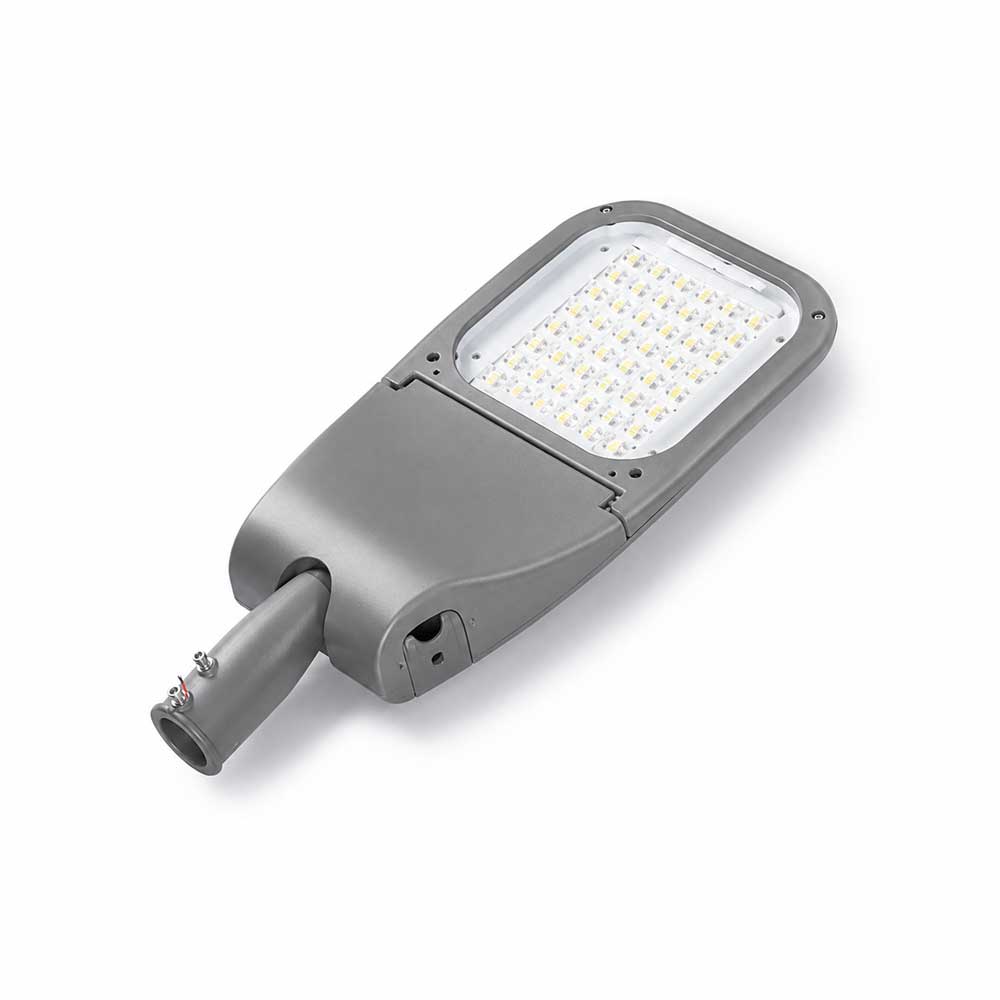
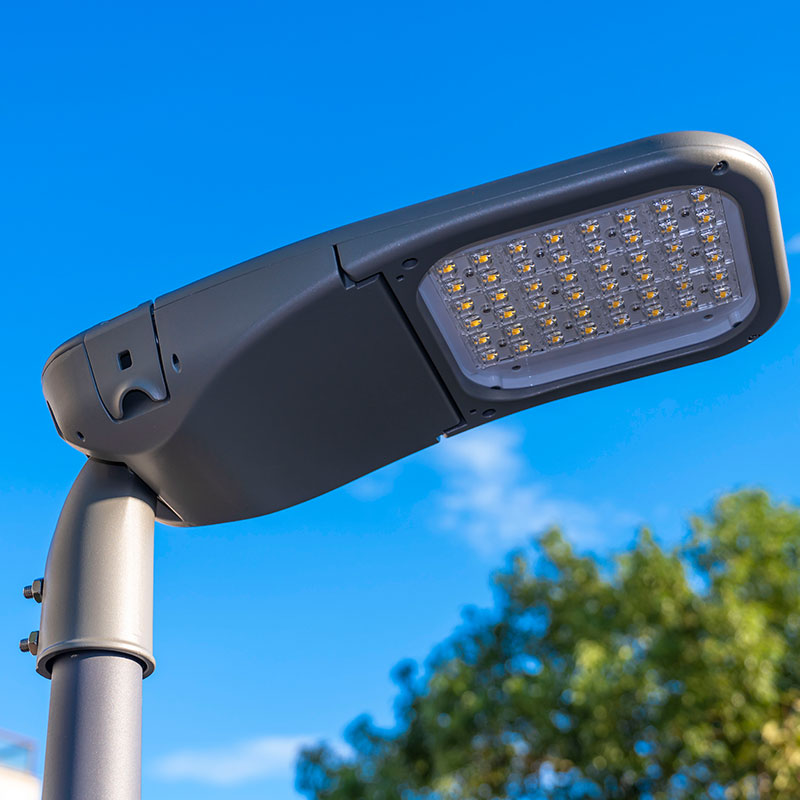
Luxific street light products include multiple optical distributions designed for different road applications. Its PIECES series provides Type I to Type V options, allowing the optical configuration to be evaluated according to the project geometry.
3. Check Bracket, Tilt, and Optical Compatibility
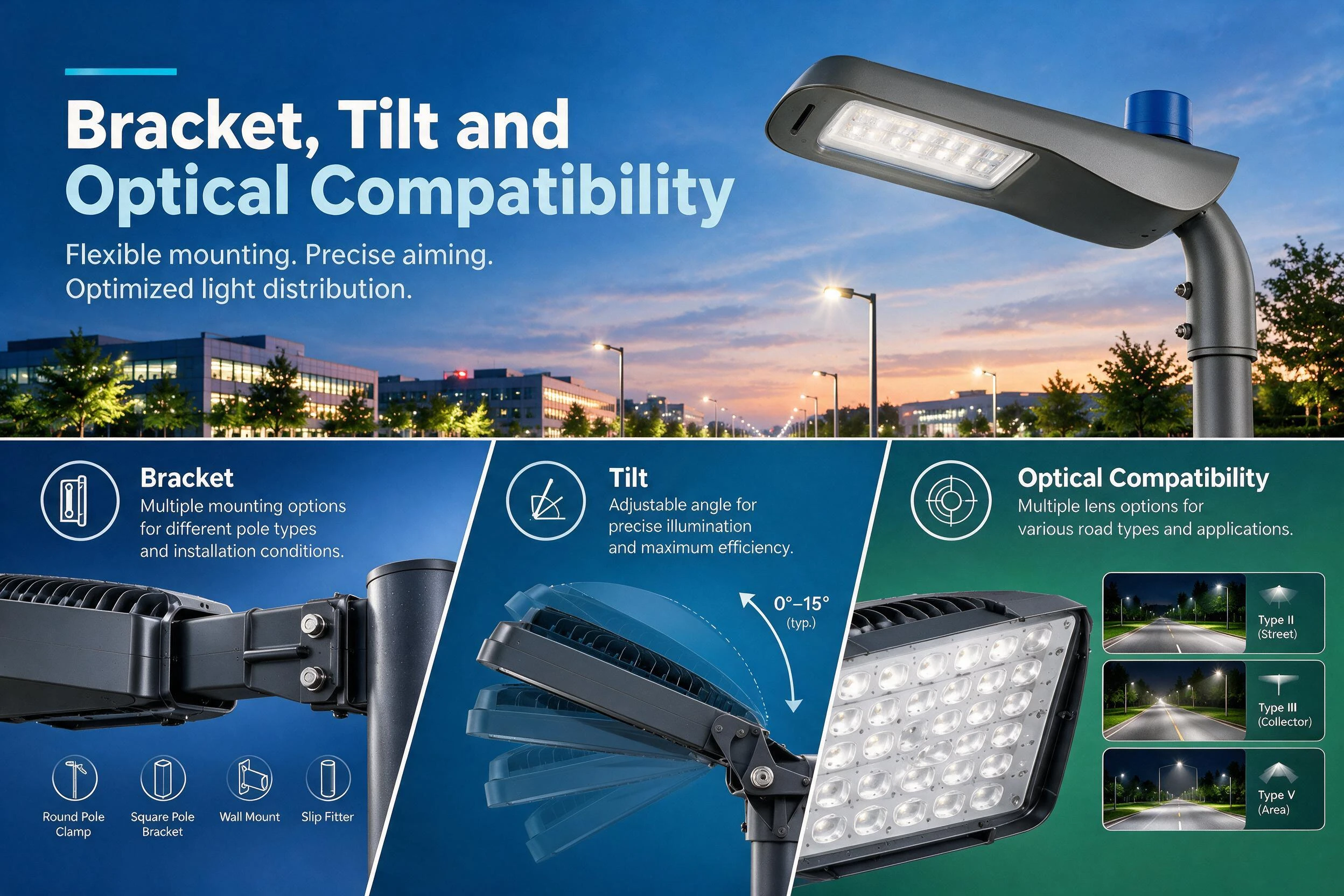
Even when the LED fixture has suitable photometric performance, the retrofit can become difficult if the mounting interface does not match the existing pole. Mechanical compatibility should therefore be checked before ordering the production quantity.
Mechanical Compatibility Checklist
- Mounting pipe diameter
- Bracket dimensions
- Fixture weight
- Insertion depth
- Mounting direction
- Available tilt adjustment
- Required electrical connection
- Clearance around the fixture
Why Tilt Matters
The mounting angle changes where the light reaches the road. A small change in tilt can affect forward throw, lateral coverage, glare, and uniformity. The selected tilt should therefore be included in the photometric calculation rather than adjusted informally after installation.
When a Custom Bracket Is the Better Solution
Some retrofit projects use older poles with nonstandard mounting dimensions. In these situations, a Customizable bracket or fixture interface may reduce unnecessary infrastructure replacement and make installation more practical.
Luxific has supported an industrial port project with a custom OEM solution, including a specific bracket designed for installation on existing high mast poles. The project also included photometric analysis to evaluate coverage and unwanted light spill.
This type of project support can be valuable for EPC contractors, infrastructure contractors, public lighting companies, and lighting integrators working with existing assets.
4. Select Optics According to the Existing Road Layout
Retrofit design should consider the existing pole arrangement instead of assuming that the optical distribution of the old fixture can simply be copied. LED optics provide an opportunity to redirect light more accurately toward the required area.
Optical Selection Factors
- Road width
- Pole height
- Pole spacing
- Single side or opposite side installation
- Staggered pole arrangement
- Mounting angle
- Required uniformity
- Nearby properties and light spill considerations
Luxific provides Type I to Type V optical options on applicable street light models. Its documented PIECES configuration also includes smart control options and surge protection, allowing electrical and optical requirements to be considered as part of one retrofit specification.
Control Glare and Unwanted Light
Retrofitting a brighter fixture does not automatically create a better lighting system. Excessive light directed toward homes, offices, pedestrian areas, or neighboring properties can create complaints and reduce visual comfort. The optical design should place light where it is needed while respecting the surrounding environment.
5. Verify Energy Savings, Maintenance, and Payback
The business case for an LED retrofit should consider more than the difference between old and new fixture wattage. Operating hours, dimming, maintenance requirements, replacement frequency, installation costs, and electricity prices all influence the actual project economics.
Build the Energy Calculation
- Record the existing fixture power.
- Record the proposed LED fixture power.
- Estimate annual operating hours.
- Include the proposed dimming strategy when applicable.
- Calculate expected annual energy consumption.
- Compare the estimated energy cost before and after retrofit.
Build the Maintenance Calculation
- Existing lamp replacement frequency
- Access equipment required for maintenance
- Labor requirements
- Replacement component availability
- Expected LED maintenance requirements
- Warranty conditions
- Future service accessibility
Luxific promotes LED outdoor lighting with long service life and low maintenance requirements, while its product designs include practical service considerations. Actual maintenance performance should always be evaluated according to operating conditions, installation environment, and project requirements.
Use a Simple Retrofit Decision Matrix
| Decision area | Preferred project approach |
|---|---|
| Energy | Compare actual operating power and control strategy |
| Lighting | Validate illuminance and uniformity through photometrics |
| Installation | Reuse suitable poles and confirm mounting compatibility |
| Maintenance | Consider service access and component replacement |
| Compliance | Confirm destination market certifications and testing documents |
| Payback | Compare energy, maintenance, installation, and equipment costs |
6. Choose a Retrofit Manufacturer That Can Support the Project
For large retrofit programs, the relationship with the Manufacturer can be as important as the fixture itself. Contractors and public lighting buyers often need technical communication, samples, documentation, customization, production coordination, and delivery planning throughout the project.
What to Ask the Supplier
- Can the Supplier provide photometric files?
- Can the fixture fit the existing pole arrangement?
- Can the mounting interface be customized?
- Can the product support required dimming or smart controls?
- Can relevant certification and testing documentation be provided?
- Can samples be supplied for site testing?
- Can production support the required quantity?
- Can delivery be coordinated with the installation schedule?
Luxific has experience supporting project specific outdoor lighting and provides OEM and ODM services. Its customization capability includes appearance, materials, dimensions, colors, branding, packaging, prototyping, quality control, and logistics.
For a Wholesaler or project distributor, this flexibility can also support market specific product configurations and private branding requirements.
7. Plan the Retrofit in Phases When Project Risk Is High
For large municipal, commercial, or campus upgrades, a staged approach can reduce uncertainty before full procurement.
- Audit the existing lighting infrastructure.
- Define the required lighting performance.
- Select candidate LED configurations.
- Complete photometric calculations.
- Verify brackets and mounting compatibility.
- Review electrical and control requirements.
- Test samples on representative locations when appropriate.
- Confirm documentation and certifications.
- Approve the final specification.
- Proceed with the larger production order.
Luxific has documented a Northern Canada project where samples, testing data, and certification documentation were provided for customer evaluation under severe winter conditions before the larger order proceeded. This demonstrates the value of validating a product against real site conditions when the environment is demanding.
Conclusion: Start Your LED Retrofit With Project Data
Send Luxific your road dimensions, pole height, target illuminance, quantity, required market certifications, and delivery schedule. Our team can support retrofit selection, photometric evaluation, mounting compatibility, customization, and quotation.