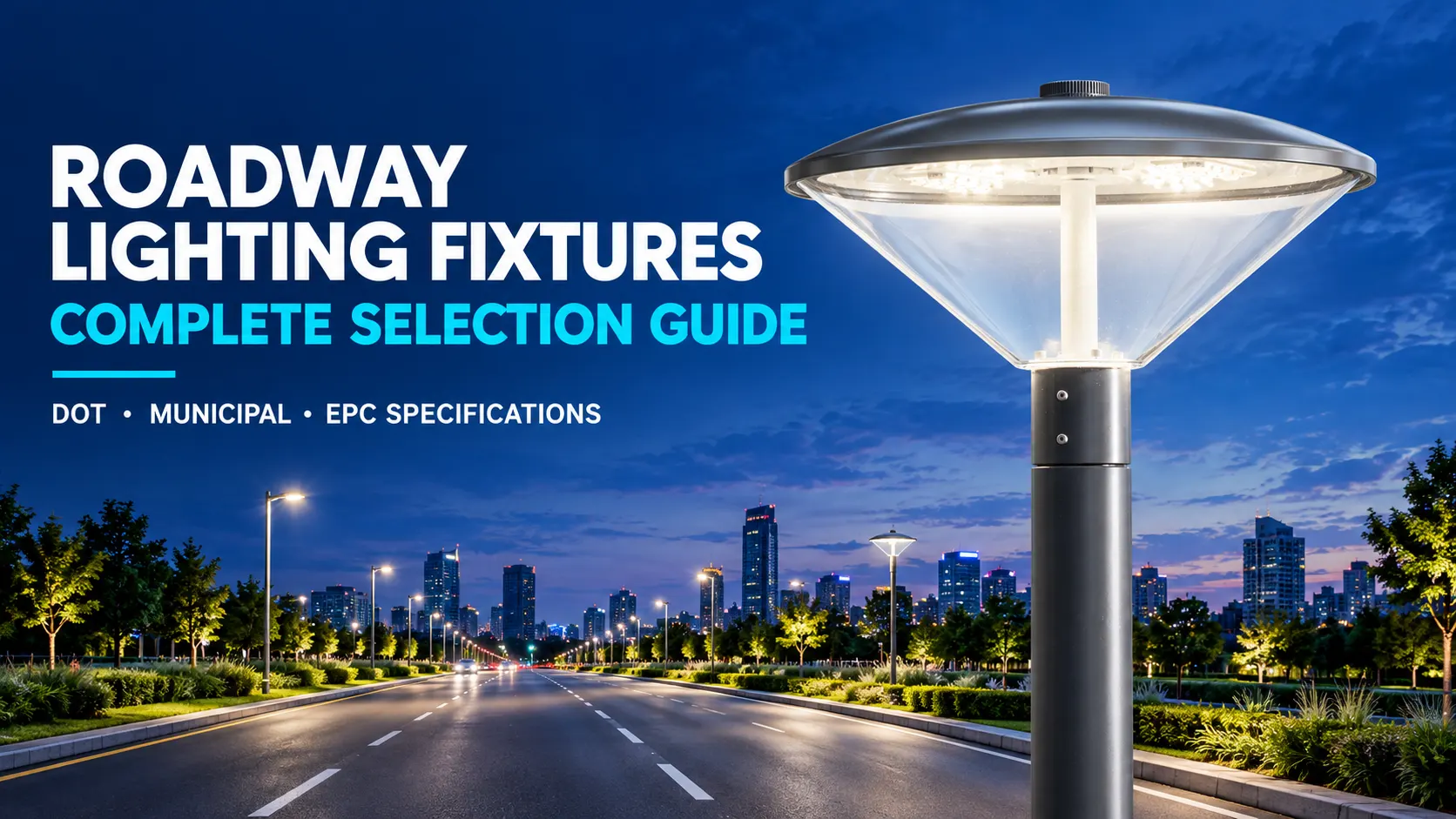
Choosing roadway lighting fixtures by wattage or purchase price alone can create costly project risks. Poor optical distribution may leave dark spots or excessive glare, while overstated lumen data can undermine compliance and energy targets. Weak weather protection, unsuitable pole geometry, or missing certification documents can also delay approval and increase maintenance costs. For DOT, municipal and EPC projects, the real priority is a fixture engineered around the road, specification, environment and lifecycle—not simply a low-cost luminaire.
The best roadway lighting fixture is selected by matching road classification, target illuminance, maintained output, optical distribution, pole geometry, controls, certifications and lifecycle cost. Luxific combines project-oriented LED design, customizable optics, durable construction, smart-control options and international certifications to support specification-driven roadway projects.
1. Start With Road Class and Application Inputs
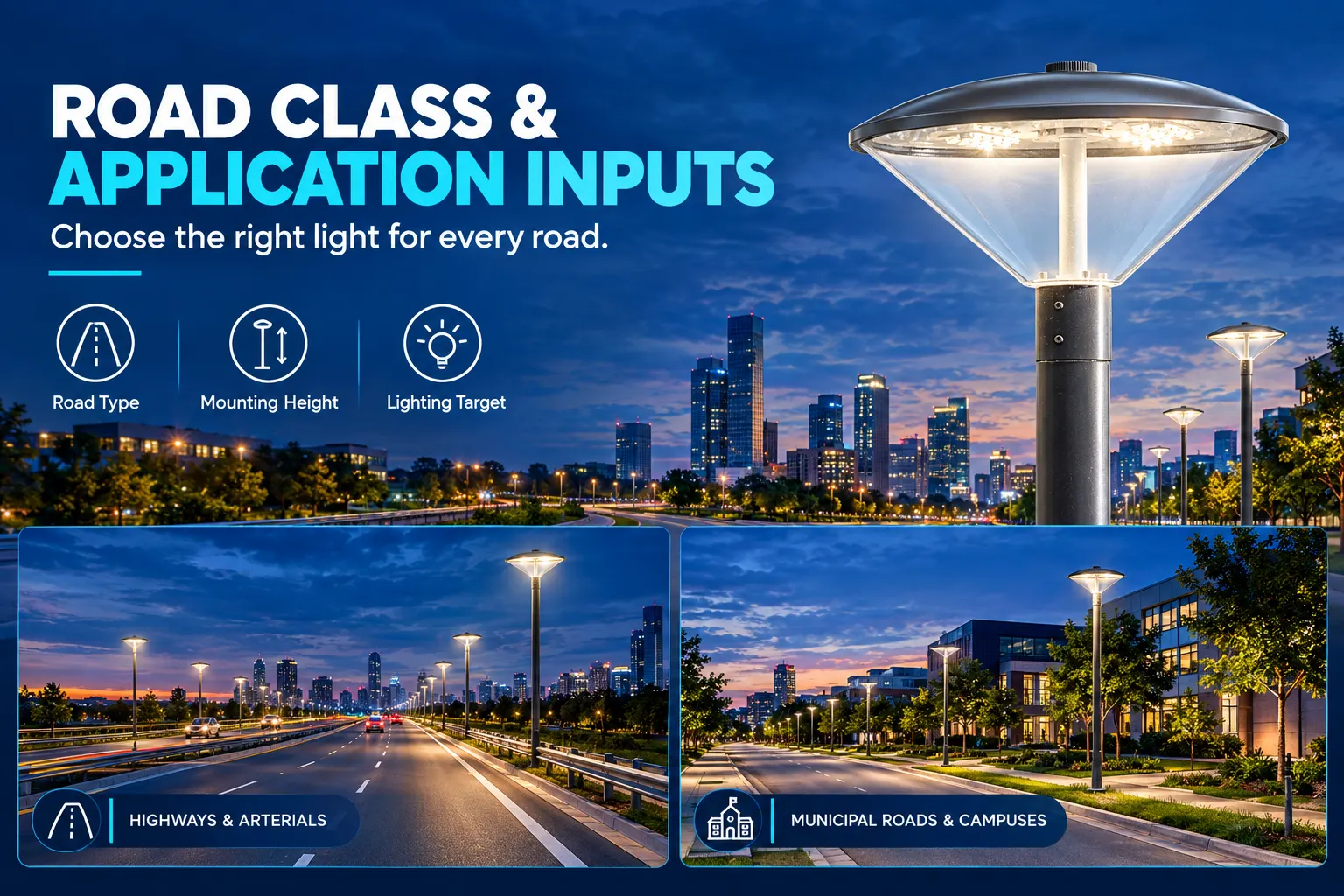
A reliable selection begins with the application rather than the fixture catalogue. DOTs, municipalities and EPC contractors should define the roadway environment, geometry and performance target before comparing suppliers.
Key project inputs
- Road classification and traffic conditions
- Roadway width, number of lanes and median arrangement
- Pole height, spacing, outreach and mounting configuration
- Required illuminance and uniformity
- Pedestrian, cycling and intersection requirements
- Environmental conditions such as temperature, moisture, dust and salt exposure
- Local electrical, photometric and safety requirements
- Required certifications, testing reports and documentation
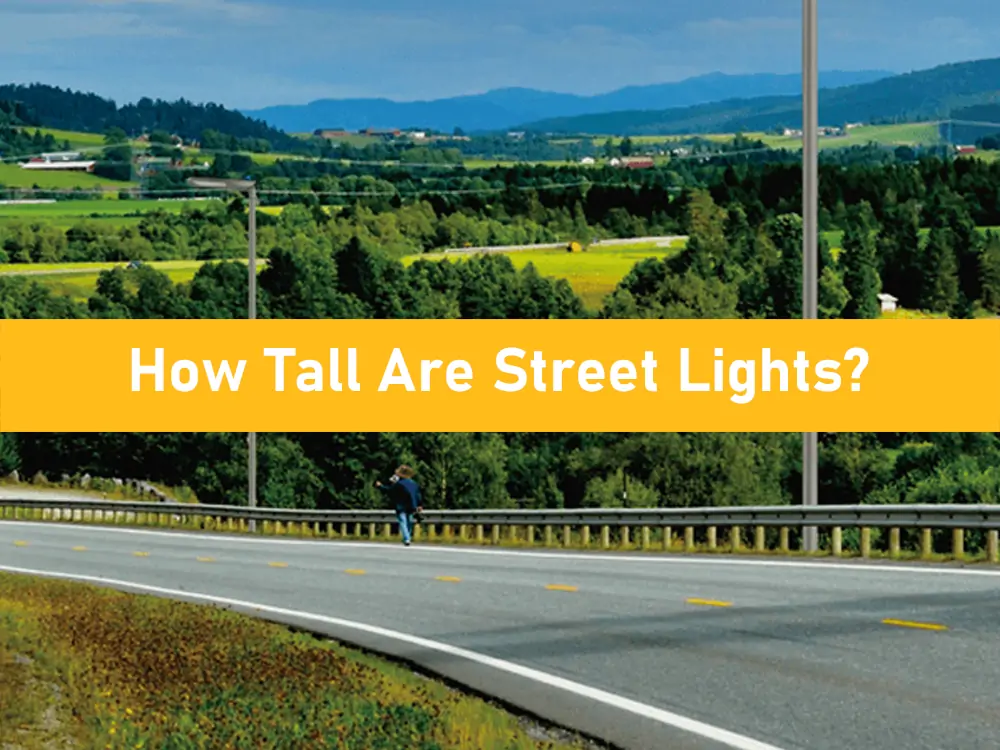
Road geometry directly affects fixture performance. Luxific product information notes that pole height, spacing, roadway width and light distribution must be considered together. A fixture mounted too high or too low can create poor uniformity, glare or unnecessary energy consumption.
| Application | Primary selection priority | Typical design consideration |
|---|---|---|
| Urban streets | Uniformity and glare control | Optics, mounting geometry and pedestrian environment |
| Highways | Long-range coverage and safety | Pole spacing, optical distribution and maintained output |
| Residential roads | Visual comfort and safety | Controlled distribution and suitable CCT |
| Intersections | Visibility and conflict-zone coverage | Higher attention to layout and uniformity |
| Parking and logistics areas | Wide-area illumination | Area coverage, mounting height and glare control |
2. Compare Lumens, Efficacy and Maintained Output
Lumens alone do not determine whether a roadway fixture will meet a project specification. Lumens describe total light output, while lux describes the amount of light reaching a defined area. Therefore, the fixture must be evaluated within the complete photometric design rather than through a single lumen figure.
Do not evaluate efficacy in isolation
- Check delivered fixture lumens rather than relying only on LED-chip output.
- Review luminous efficacy together with optical efficiency and driver performance.
- Confirm the maintained-output assumptions used for the project calculation.
- Request LM-79, TM-21 or other applicable testing documentation when required.
- Compare energy consumption against the actual lighting result on the roadway.
Luxific identifies accurate lumen-efficacy data as an important quality-control consideration because overstated specifications can lead to underperforming lighting systems.
Why maintained output matters
A DOT or municipal project is not purchased for the first night of operation. The design must remain suitable throughout its expected service period. LED chip quality, thermal management, driver reliability, environmental protection and optical stability all influence long-term performance.
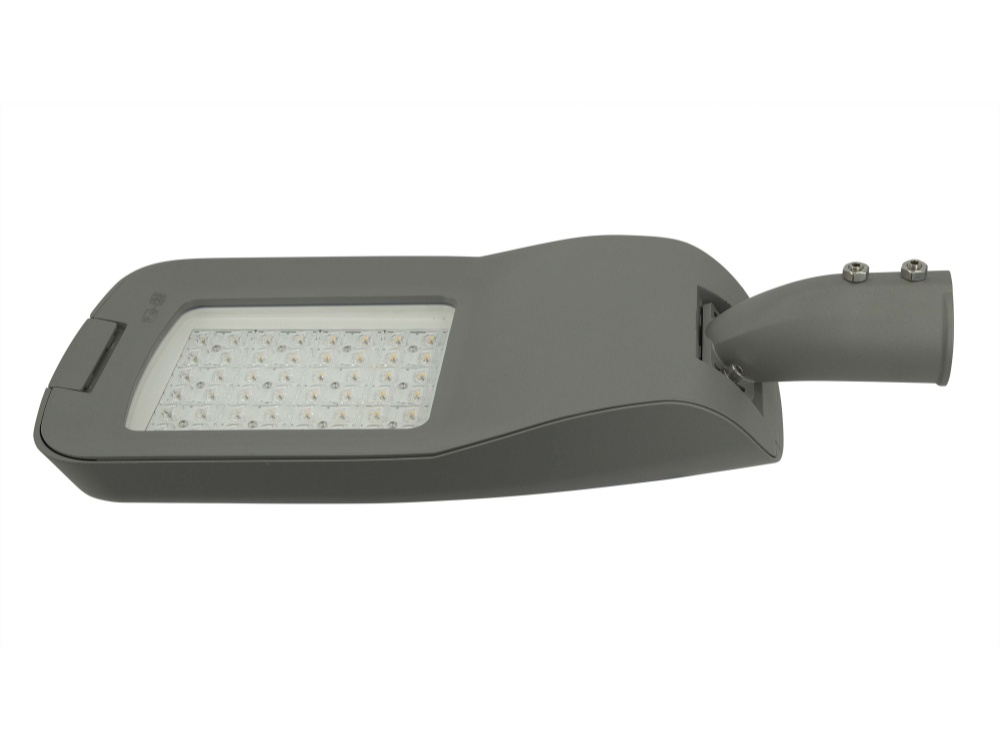
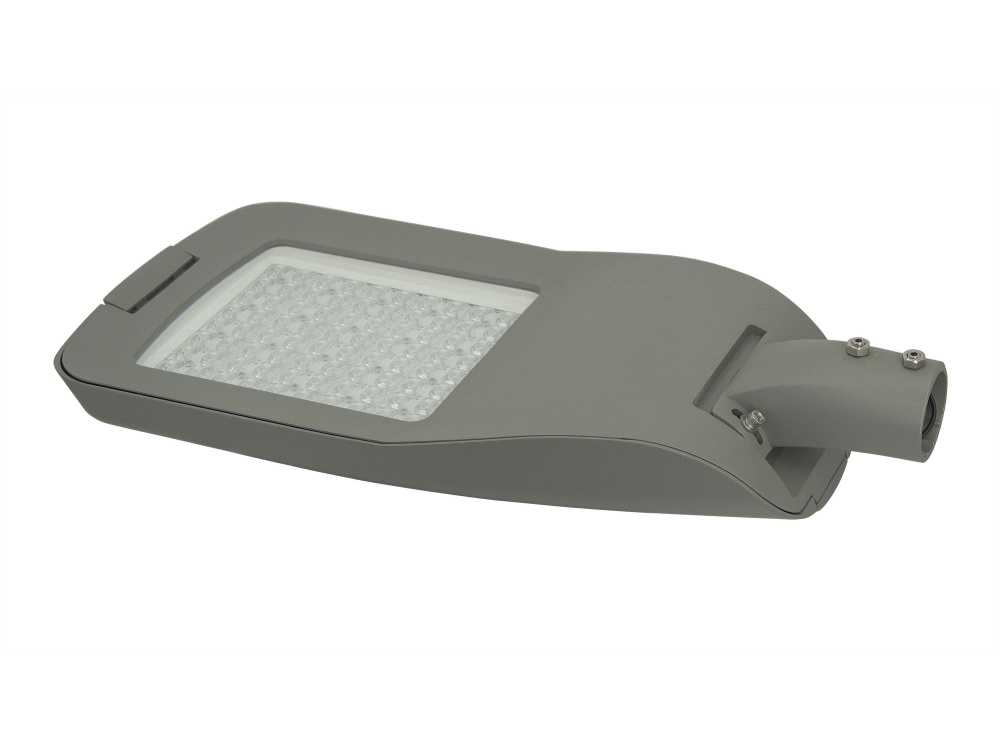
For example, Luxific roadway products can incorporate die-cast aluminum construction, integrated cooling features and modular designs. The VEGA series supports tool-free opening and future upgrades, while its specifications include IP66 protection and surge protection up to 10kV, 10kA.
3. Match Optical Distribution to Pole Geometry
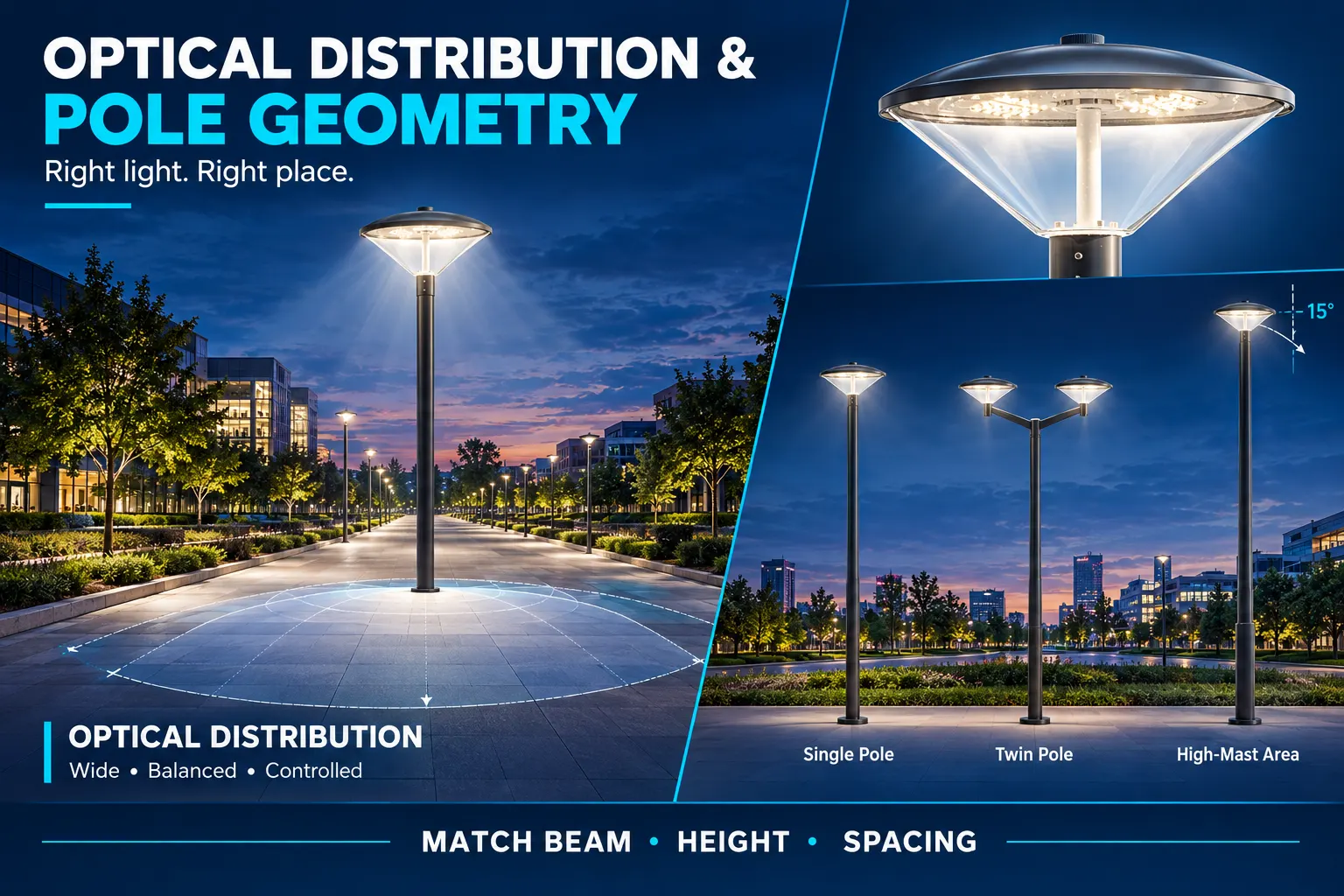
Optical distribution is one of the most important decisions in roadway lighting because the same fixture can produce very different results when pole height, spacing, roadway width and mounting angle change.
Use the complete geometry
- Define the roadway cross-section and lane arrangement.
- Confirm pole height and longitudinal spacing.
- Identify the mounting side, outreach and tilt angle.
- Select an optical distribution suited to the geometry.
- Run a photometric simulation before final approval.
- Check illuminance, uniformity, glare and light spill against the project specification.
Luxific offers roadway optics designed for different applications. The PIECES series, for example, provides multiple Type I to Type V distributions intended to support different road layouts, improve uniformity and reduce glare.
Optics should solve the roadway problem
- Wide distributions can support broader coverage.
- Asymmetric distributions can help throw light across wider roads.
- Controlled optics can reduce unnecessary light beyond the roadway.
- Appropriate beam selection can reduce dark areas between poles.
- Correct aiming can improve visibility while limiting glare.
Luxific project experience also demonstrates the value of photometric analysis. In a port project, asymmetric optics were selected for large areas, and a photometric report was provided to evaluate coverage and light trespass before implementation.
4. Evaluate Controls, Certifications and Lifecycle Cost
Controls can reduce unnecessary operating cost
Modern roadway lighting may require more than on and off switching. Depending on the project specification, dimming and smart controls can support different operating schedules and energy-management strategies.
Luxific roadway solutions can support DALI, 0-10V, Astro Dim and Step Dim control inputs, with options including photocells, NEMA sockets and Zhaga interfaces.
- Confirm whether the municipality requires photocell control.
- Check compatibility with the selected control platform.
- Define dimming schedules before equipment selection.
- Consider future smart-city integration where applicable.
- Ensure control components do not create additional maintenance complexity.
Certification is part of supplier qualification
For public infrastructure projects, certification should be treated as a procurement requirement, not a marketing statement. Ask the Manufacturer or Supplier for the exact certificate and test report applicable to the proposed model and market.
Luxific states that its product portfolio includes certifications and testing such as CE, CB, ENEC, EMC, LM-79, TM-21 and IEC 62471, depending on the product. Its company information also identifies ISO 9001, CE, RoHS and CB among its certification framework.
| Qualification area | What buyers should verify | Why it matters |
|---|---|---|
| Photometric data | IES/LDT files and test information | Supports project calculations |
| Electrical safety | Applicable certificates and reports | Supports specification compliance |
| Environmental protection | IP and IK ratings | Reduces environmental and impact risks |
| Surge protection | Specified SPD performance | Protects electronics in demanding networks |
| Quality system | Factory management certifications | Supports consistent production |
| Warranty and support | Written terms and technical response | Reduces lifecycle uncertainty |
Think in total lifecycle cost
The lowest purchase price is rarely the complete economic picture. A better procurement comparison considers energy consumption, replacement frequency, maintenance access, spare parts, installation time, warranty support and the potential cost of project delays.
Luxific positions itself as a direct factory Manufacturer and Supplier, with OEM and ODM capabilities for project-specific requirements. Its customization services can include materials, dimensions, colors, branding and packaging, while its engineering process covers design, prototyping, quality control and logistics.
5. Build a Specification Checklist Before Selecting a Supplier
Whether you are a municipal buyer, EPC contractor, infrastructure contractor or Wholesaler, use a structured comparison instead of selecting purely on price.
- Define road class, application and lighting targets.
- Provide roadway dimensions, pole height and spacing.
- Request photometric files and project calculations.
- Compare fixture lumens, efficacy and maintained output assumptions.
- Verify optics, CCT, CRI, glare control and mounting options.
- Check IP, IK, surge protection and environmental temperature ratings.
- Verify all required certificates and testing documents.
- Review warranty, spare parts and maintenance arrangements.
- Confirm production capacity, quality control and delivery schedule.
- For branded or special projects, evaluate Customizable, OEM or ODM capability.
Luxific has supplied LED outdoor lighting for municipal, infrastructure and industrial applications and operates as a factory with project-oriented customization capabilities. Its product portfolio covers LED street lights, solar street lights, flood lights, high mast lighting and other outdoor lighting categories.
Make the Roadway Fixture Selection Decision With Project Data
Send Luxific your road dimensions, pole height, target illuminance, quantity, required market certifications and delivery date. Our team can use these inputs to recommend suitable roadway lighting fixtures, prepare project-oriented specifications and develop a quotation for your application.