Why Common Street Lighting Failures Become Expensive Municipal Problems
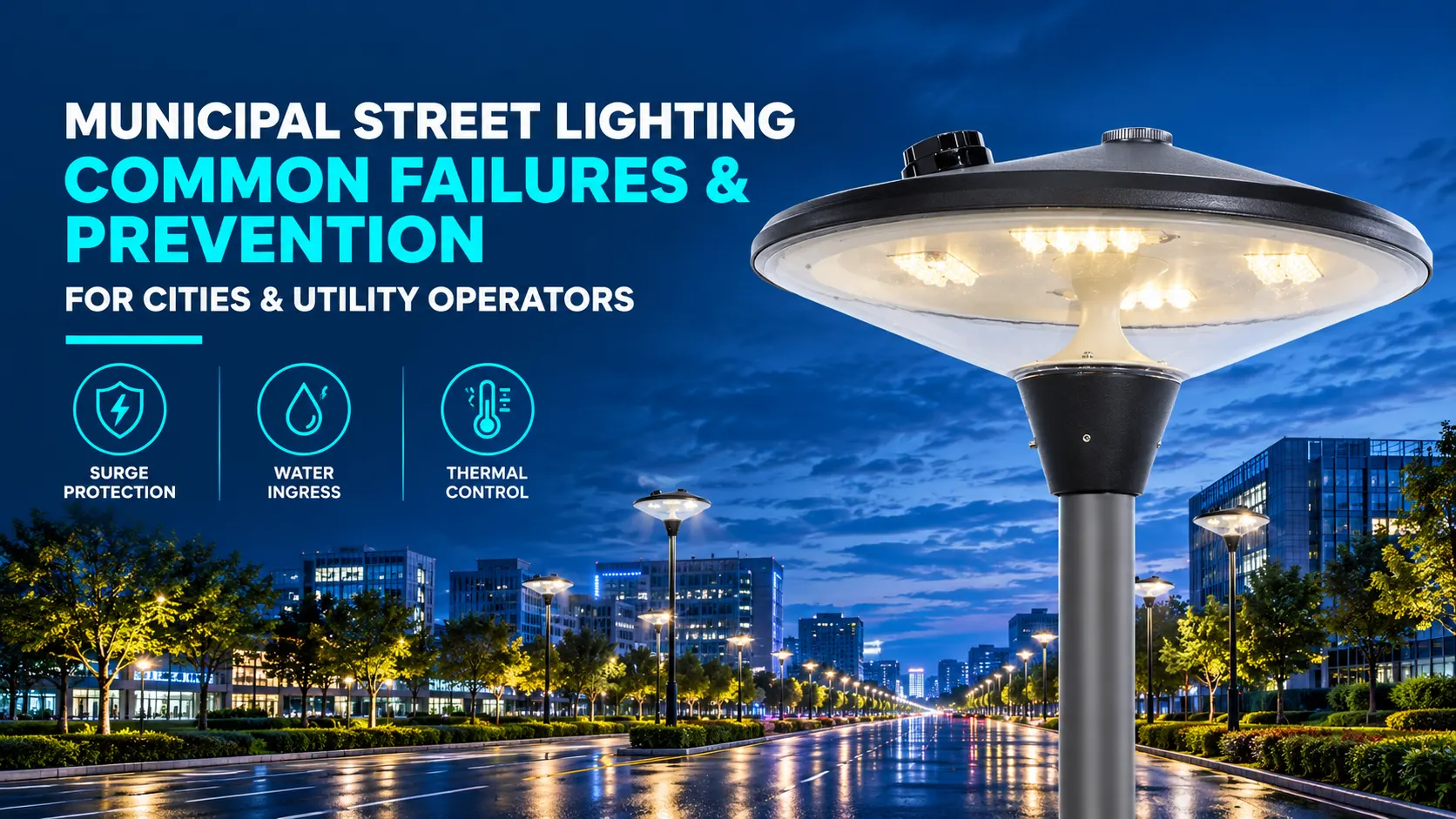
Municipal street lighting failures rarely begin with one obvious defect. Glare can reduce visual comfort, poor uniformity can leave dark areas, and water ingress, surge events, or overheating can shorten component life. When these risks are discovered after installation, cities may face complaints, maintenance costs, redesign work, or project delays. The solution is prevention: define performance requirements clearly, match optics and installation geometry, specify environmental protection, verify documentation, and commission the system before final acceptance.
Prevent street lighting failures by controlling glare, verifying illuminance and uniformity, protecting against surge and water ingress, managing thermal performance, and commissioning against the approved specification. Luxific supports technical design, LED street lighting customization, OEM and ODM services, and project-oriented quality control.
1. Glare and Over-Lighting
More light does not automatically mean better street lighting. Excessive brightness, poorly controlled beams, or unsuitable mounting angles can create glare for drivers and pedestrians while wasting energy outside the roadway. A successful municipal project should focus on useful light where it is needed rather than simply maximizing lumen output.
Common Causes of Glare
- Optical distribution does not match the road width or pole spacing.
- Luminaire mounting angle is not optimized for the application.
- Excessive light output is selected without photometric verification.
- Light is unnecessarily directed toward buildings, sidewalks, or adjacent properties.
- Existing pole geometry is retained without checking compatibility with the new LED optics.
How to Prevent Over-Lighting
- Define the required illuminance or luminance before selecting wattage.
- Identify the road geometry and mounting conditions.
- Select an appropriate optical distribution.
- Evaluate glare and light spill as part of the photometric design.
- Confirm the final installation angle and control strategy.
Luxific product information describes multiple optical distribution options and optical control intended to support uniform illumination and glare reduction. The appropriate configuration should still be confirmed through project-specific design rather than assumed from a product name alone.
2. Dark Spots and Poor Uniformity
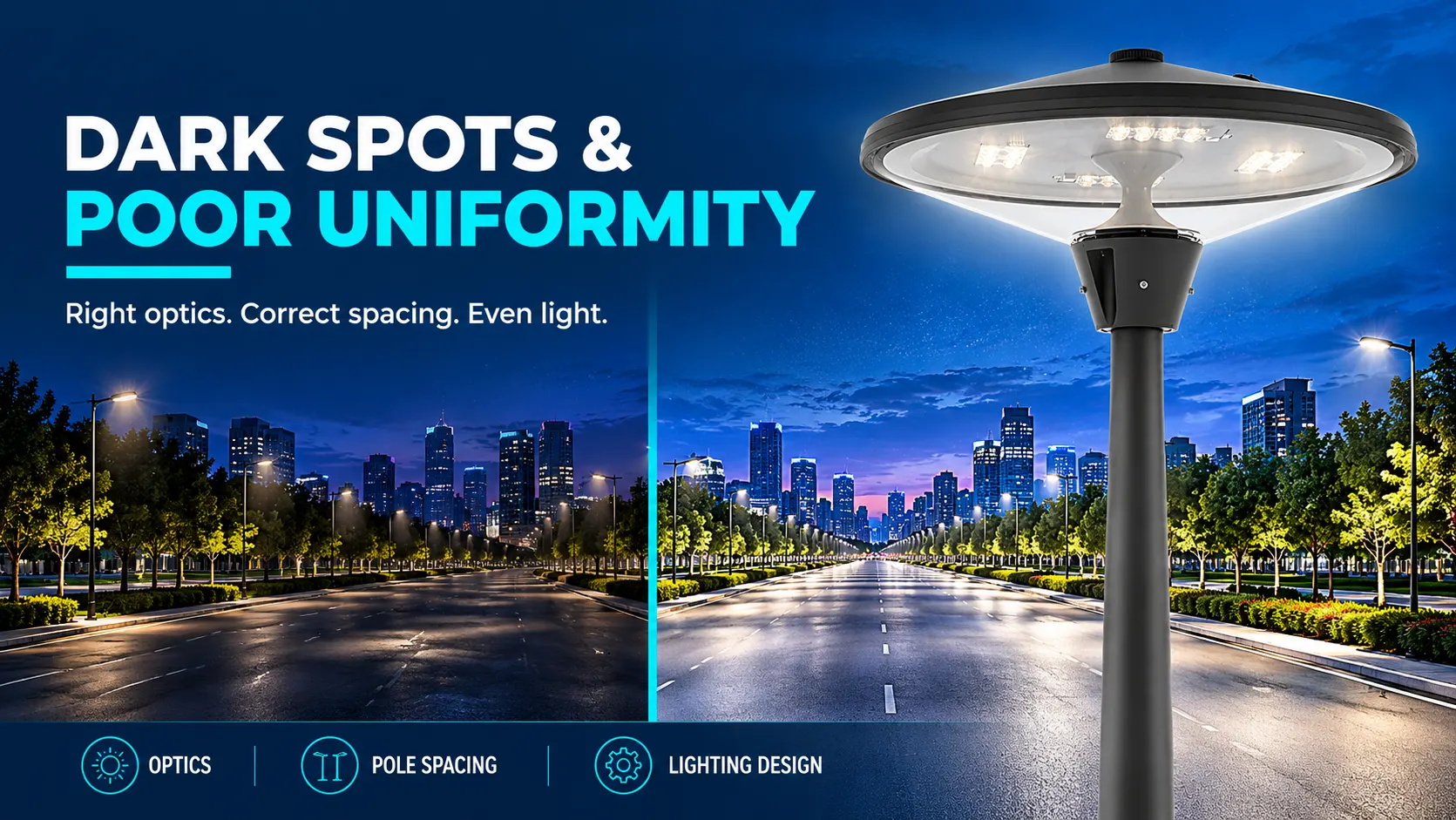
Dark spots often appear when fixture spacing, mounting height, optical distribution, and road width are treated independently. A road may have an acceptable average illuminance while still containing poorly illuminated areas. For cities and utility operators, uniformity should therefore be included in the specification and verified during design.
Typical Causes
| Failure | Possible Cause | Prevention |
|---|---|---|
| Dark areas between poles | Excessive pole spacing or unsuitable optics | Validate spacing with photometric calculations |
| Uneven road illumination | Incorrect mounting angle | Optimize tilt and optical distribution |
| Insufficient road coverage | Luminaire distribution does not match road width | Review road geometry before product selection |
| Inconsistent results | Different configurations used without validation | Standardize approved models and installation parameters |
Use Photometrics Before Procurement
The design process should evaluate the complete installation rather than only the luminaire datasheet. Road width, pole height, spacing, mounting arrangement, optical distribution, and target illuminance should be modeled together.
- Collect road and pole dimensions.
- Define the required lighting criteria.
- Select a preliminary LED luminaire and optic.
- Run the photometric calculation.
- Review average performance and uniformity.
- Adjust optics, spacing, or mounting conditions when necessary.
This approach is especially important when an existing HPS or MH system is being replaced. LED technology should be selected according to lighting performance rather than a simple watt-for-watt replacement.
3. Surge, Water Ingress and Overheating

Outdoor luminaires operate in demanding environments. Electrical surges, rain, humidity, dust, high temperatures, and poor heat dissipation can all affect long-term performance. A municipal specification should therefore address environmental protection and thermal conditions before procurement.
Control Surge Risk
LED drivers and electronic components can be sensitive to electrical disturbances. Tender documents should clearly state the required surge protection level and applicable testing requirements. Buyers should also verify that the proposed product configuration corresponds to the submitted technical documentation.
- Define the required surge protection level.
- Specify applicable electrical standards.
- Request supporting test documentation.
- Confirm the driver and protection configuration.
- Check compatibility with the existing electrical network.
Prevent Water Ingress
IP protection should be considered according to the actual installation environment. Coastal roads, ports, industrial zones, and areas with heavy rainfall may present different environmental risks from dry urban locations.
Project specifications should identify the required IP level and request relevant evidence. Buyers should also confirm that the stated rating applies to the actual production configuration rather than a different product version.
Manage Thermal Performance
LED efficiency does not eliminate the need for thermal design. The housing, heat dissipation structure, driver, LED system, and ambient temperature should be evaluated together.
- Define the expected ambient temperature range.
- Review housing and heat dissipation design.
- Check driver operating conditions.
- Consider installation locations with high solar or ambient heat.
- Request relevant technical documentation before approval.
Luxific describes its LED street lighting products as incorporating heat management and durable outdoor construction, while its documented manufacturing capabilities include quality control and technical design. Specific environmental performance should always be matched to the selected model and project conditions.
4. How Specifications Prevent Failures
Many field problems can be reduced before installation by writing measurable requirements into the tender. A professional specification should describe what must be achieved and what evidence the Supplier must provide.
Build a Clear Technical Specification
- Road classification and application
- Target illuminance or luminance
- Uniformity requirements
- Pole height and spacing
- Optical distribution
- Mounting angle and bracket requirements
- Driver and surge protection
- IP and IK requirements
- Corrosion resistance
- Operating temperature range
- Required certifications and test reports
- Photometric files and calculations
- Warranty and maintenance requirements
Verify the Supplier Before Approval
For cities, EPC contractors, infrastructure contractors, and public lighting companies, supplier verification should extend beyond price. A capable Manufacturer should be able to provide consistent technical documentation, communicate clearly, and support the project through design, production, delivery, and after-sales stages.
Luxific identifies itself as a professional LED street light Manufacturer and provides OEM and ODM customization, technical design, prototyping, quality control, and logistics support. Its documented certifications and testing information include ISO 9001, CE, RoHS, CB, LM79, and TM21, with exact applicability depending on the selected product and project.
5. Commissioning Prevents Problems from Becoming Long-Term Failures
Even a well-written specification can fail if the installed product differs from the approved configuration. Commissioning provides a final opportunity to verify that the delivered and installed system matches the project requirements.
Commissioning Checklist
- Verify the installed luminaire model and configuration.
- Check mounting height, orientation, tilt, and bracket installation.
- Confirm electrical connections and control settings.
- Inspect visible housing, seals, and mechanical installation.
- Confirm that the installed products correspond to approved documentation.
- Check lighting performance where project testing requires it.
- Record deviations and correct them before final acceptance.
- Keep final technical documents for future maintenance.
Prevent Documentation Gaps
Good documentation should remain available after commissioning. Cities and utility operators may need product specifications, certificates, photometric files, warranty information, maintenance instructions, and approved configuration records years after the original purchase.
6. Municipal Street Lighting Failure Prevention Checklist
| Risk | Prevention Method | Buyer Verification |
|---|---|---|
| Glare | Optical and mounting optimization | Photometric review |
| Dark spots | Correct spacing and distribution | Uniformity calculation |
| Surge damage | Defined surge protection | Technical and test documents |
| Water ingress | Appropriate enclosure protection | IP documentation |
| Overheating | Thermal and driver design | Operating temperature data |
| Installation errors | Clear mounting requirements | Commissioning inspection |
| Documentation gaps | Defined tender submission | Model-specific records |
For projects requiring Customizable configurations, Luxific can support OEM and ODM requirements related to product dimensions, materials, colors, branding, and packaging. Such customization should be confirmed against the project’s technical requirements before production.
Conclusion
Prevent municipal street lighting failures before procurement. Send Luxific your road dimensions, pole height, target illuminance, quantity, required market certifications, and delivery schedule. We can use these inputs to recommend suitable configurations and prepare a project-specific selection or quotation.