Why Poor Street Light Design Creates Expensive Project Risks
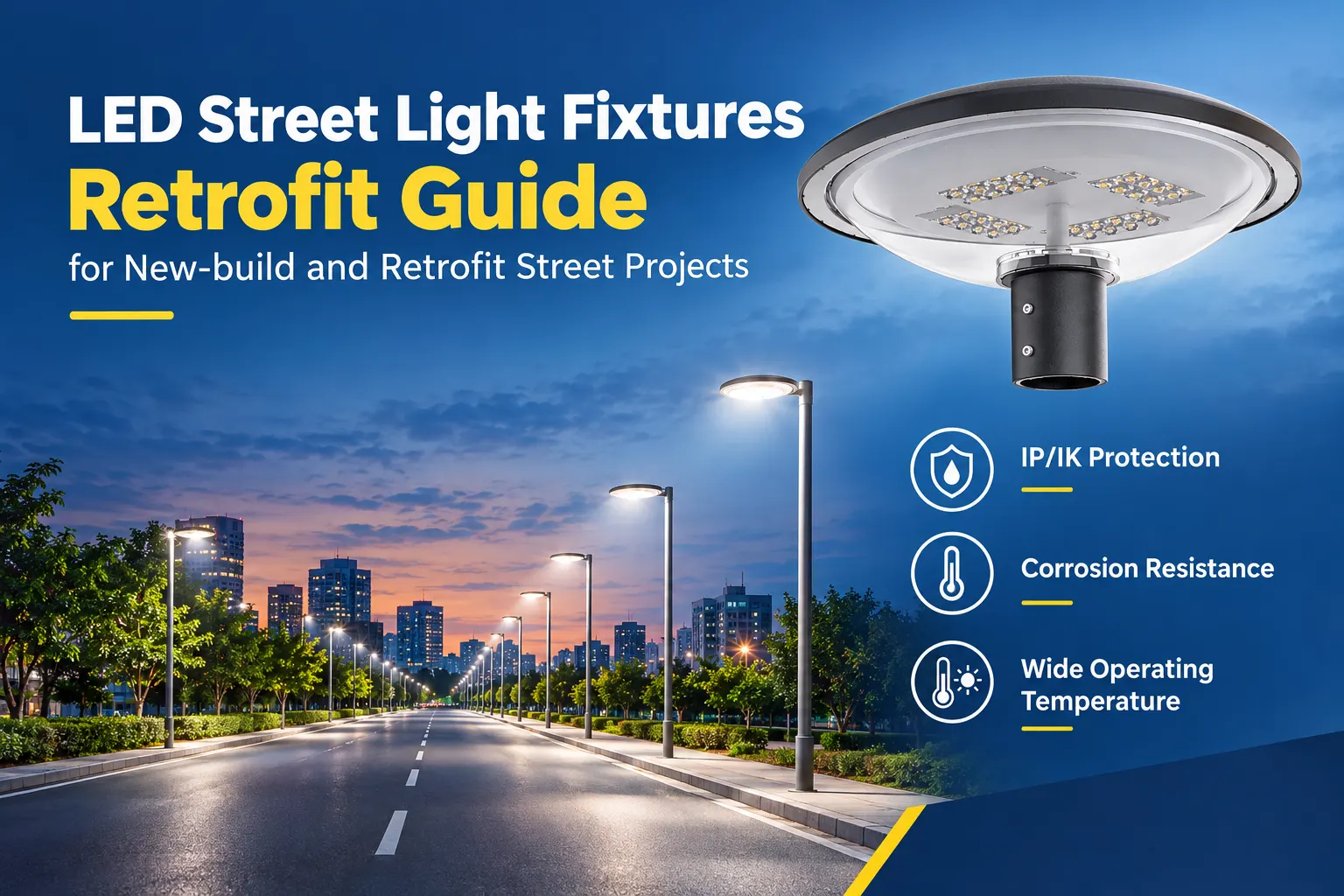
A street lighting project can fail long before installation if the fixture is selected without considering road geometry, illuminance, uniformity, pole arrangement, or photometric performance. The result can be dark zones, glare, excessive energy use, redesign costs, or delayed approval. For municipalities, EPC contractors, and lighting integrators, choosing the lowest-priced fixture can therefore create higher lifetime costs. A better approach is to design the lighting system around measurable project requirements first, then select the LED street light fixture that can deliver them reliably.
The right LED street light fixture should match illuminance and uniformity targets, pole height and spacing, road geometry, optical distribution, cutoff requirements, and verified IES or LDT photometric data. Luxific combines manufacturing, customizable street lighting solutions, OEM and ODM capabilities, and project-oriented support for different road applications.
1. Set Illuminance, Luminance and Uniformity Targets First
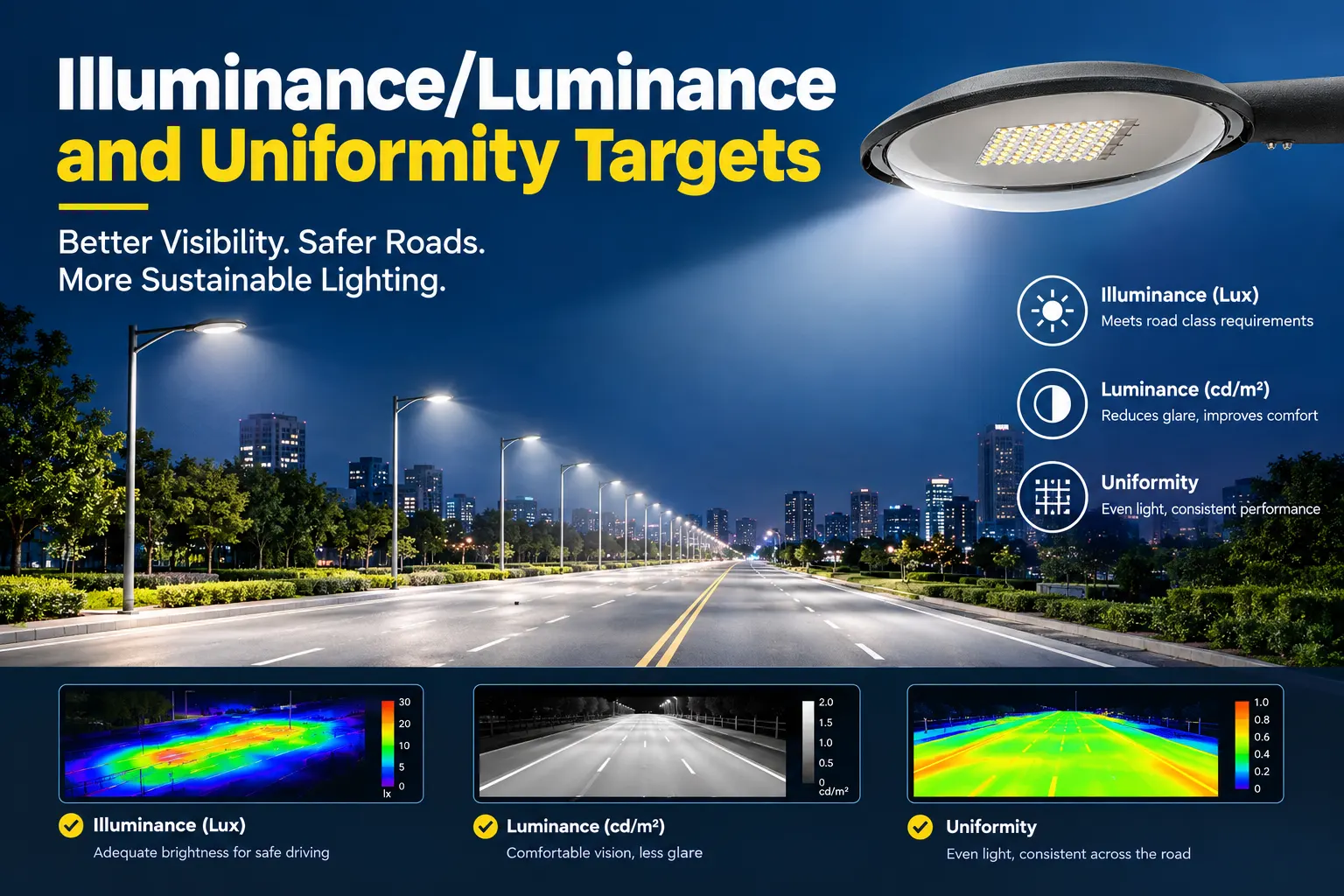
Street lighting design should begin with the lighting target rather than fixture wattage. Illuminance describes the amount of light reaching a surface, while luminance relates to the brightness perceived from a surface in the viewing direction. Depending on the project specification and road class, the designer may need to work with illuminance, luminance, or both.
For a new-build project, the lighting target should be established before selecting the luminaire. For a retrofit, the existing lighting level should also be measured so that the replacement design can be compared with the current installation.
- Identify the road classification and traffic conditions.
- Define the required illuminance or luminance level.
- Set the required overall and longitudinal uniformity.
- Establish acceptable glare and light-spill limits.
- Confirm the calculation area, maintenance factor, and operating conditions.
- Use photometric software to verify the proposed fixture quantity and arrangement.
| Design Input | Why It Matters | What to Confirm |
|---|---|---|
| Illuminance | Determines how much light reaches the road | Target lux and calculation method |
| Luminance | Important for driver visual perception on applicable road classes | Target cd/m² and viewing conditions |
| Uniformity | Reduces excessive contrast and dark areas | Overall and longitudinal uniformity |
| Glare | Affects visual comfort and road safety | Project-specific glare limits |
Luxific focuses on LED outdoor lighting for applications including city streets, highways, pedestrian areas, parking areas, and other infrastructure environments. Its customizable approach is intended to accommodate different project conditions rather than relying on one configuration for every road.
2. Design Pole Height, Spacing and Arrangement Together
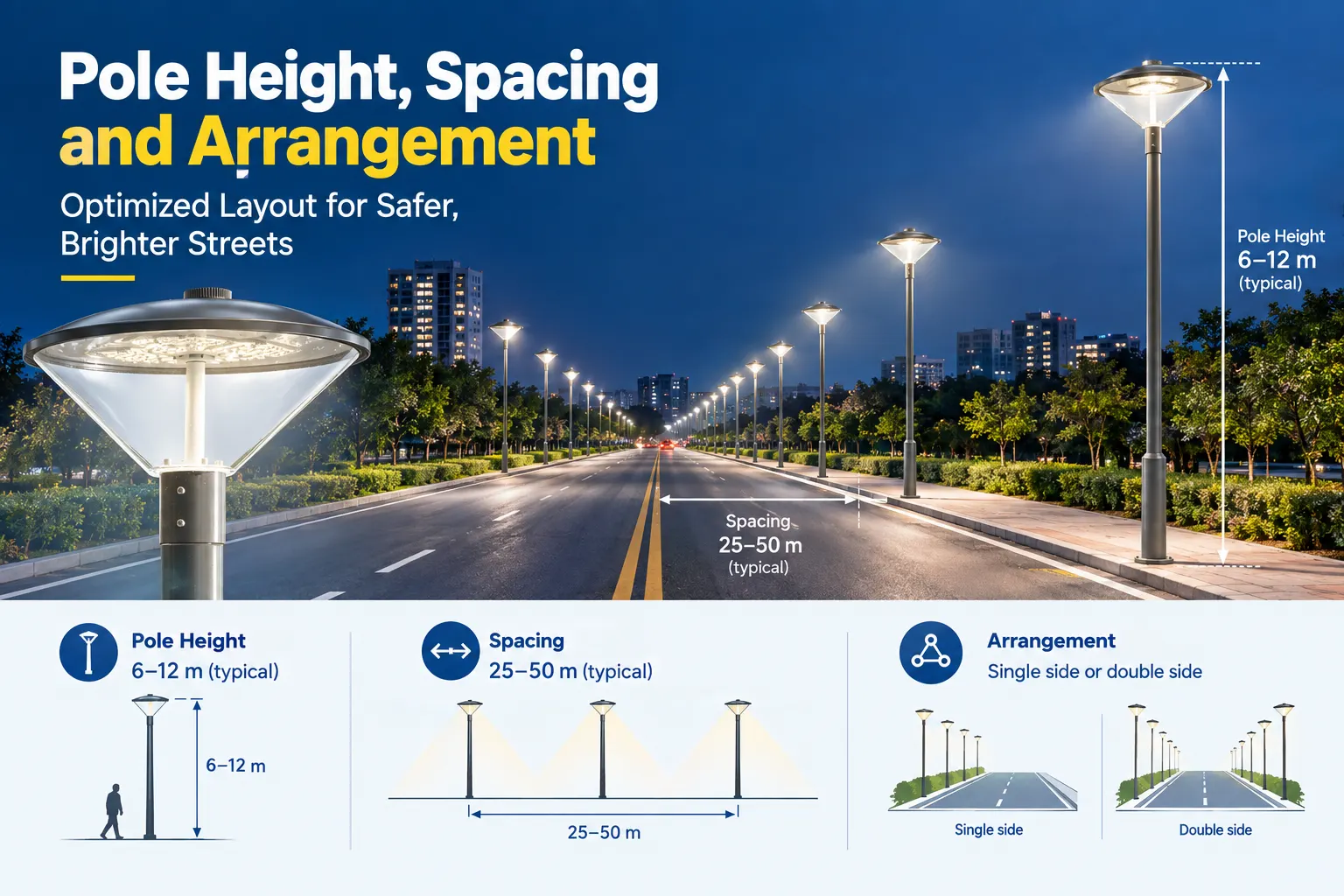
Even a high-performance LED fixture cannot compensate for an unsuitable pole layout. Pole height, spacing, road width, mounting position, arm length, and fixture tilt all influence the resulting light distribution. A fixture that performs well at one mounting geometry may require a different optical configuration when installed at another height or spacing.
New-build Projects
New-build roads offer the greatest opportunity to optimize the complete lighting system. Designers can coordinate pole height, spacing and luminaire selection before construction begins.
- Measure the complete carriageway width and lane configuration.
- Determine possible pole locations and setbacks.
- Establish practical mounting heights.
- Compare different pole spacing options through photometric simulation.
- Select the optical distribution that provides the required coverage.
- Confirm the final arrangement against project lighting standards.
Retrofit Projects
Retrofit projects are more constrained because existing poles, foundations, wiring and mounting arms often remain in place. The replacement fixture should therefore be evaluated against the actual installation geometry rather than selected only by replacing the existing wattage.
- Existing pole height and spacing
- Arm length and mounting angle
- Road width and setback
- Existing luminaire mounting interface
- Existing electrical infrastructure
- Current illumination and dark-zone problems
Luxific documentation emphasizes customizable solutions for different site demands and applications, which is particularly relevant when a standard replacement fixture does not perfectly match an existing installation.
3. Select Type I to Type V Optics According to Road Geometry
Optical distribution is one of the most important design decisions in an LED street light fixture. The objective is not simply to produce more lumens, but to place those lumens where they are needed while limiting unnecessary light outside the road area.
Understanding Type I to Type V Distribution
- Type I: Suitable for narrower roadways and applications where light needs to be concentrated around the mounting position.
- Type II: Extends the distribution farther across the roadway and can suit wider road layouts.
- Type III: Provides broader forward distribution and is commonly considered for roadways with greater coverage requirements.
- Type IV: Produces a strong forward distribution and can be useful for applications requiring more light projection away from the pole.
- Type V: Provides a more symmetrical distribution around the mounting location and may suit intersections, open areas, or specific roadway geometries.
These categories should be treated as design references rather than automatic selections. The final choice depends on mounting height, pole spacing, road width, setback, fixture orientation, required uniformity, and the actual photometric file.
Cutoff and Light Control
For modern road projects, optical control should also consider glare, light trespass and unnecessary upward or off-road illumination. A suitable distribution can improve the utilization of fixture output and support the project goal of achieving the required lighting level without simply increasing fixture power.
| Project Condition | Primary Design Question | Preferred Evaluation |
|---|---|---|
| Narrow residential road | Can the light cover the roadway without excessive spill? | Distribution and uniformity |
| Wide urban road | Can both carriageway sides receive balanced illumination? | Optics, height and spacing |
| Highway | Can long spacing maintain required road performance? | Photometric simulation |
| Intersection or open area | Is symmetrical coverage required? | Distribution and mounting arrangement |
4. Validate the Fixture With IES or LDT Photometric Files
A specification sheet can tell you the fixture wattage, rated lumens and other basic parameters, but it cannot fully demonstrate how the luminaire will perform on a particular road. IES and LDT photometric files provide the data needed for lighting calculation software to model the actual distribution.
What to Check Before Approval
- Obtain the photometric file for the exact fixture model and configuration being quoted.
- Confirm that the file corresponds to the proposed LED power, optics and mounting configuration.
- Import the file into the project lighting software.
- Enter the actual road width, pole height, spacing and setback.
- Calculate average illuminance or luminance and uniformity.
- Check areas near the road edge, intersections, pedestrian zones and other critical locations.
- Review the result against the project specification before placing the production order.
Do Not Compare Fixtures by Lumens Alone
Two LED street light fixtures with similar lumen ratings can produce significantly different road results because their optics distribute light differently. This is why professional buyers should request the photometric file, not only a catalogue specification.
For a Supplier, Manufacturer or Wholesaler, providing project-relevant technical information early can also reduce unnecessary quotation cycles. For the buyer, it creates a more objective comparison between different brands and configurations.
5. Evaluate the Fixture as a Complete Project Solution
Technical performance is only one part of street lighting procurement. Municipal authorities and contractors also need to consider reliability, certification, delivery, maintenance and customization.
- Quality: Review materials, LED components, driver selection, thermal management and protection level.
- Maintenance: Consider access to components and the practical time required for servicing.
- Compliance: Confirm that the exact model meets the certifications and standards required in the destination market.
- Delivery: Check production capacity and the Supplier ability to support the project schedule.
- Customization: Confirm whether mounting, appearance, control interfaces or other specifications can be adapted.
- Lifecycle cost: Compare energy consumption, maintenance requirements and expected service performance instead of focusing only on purchase price.
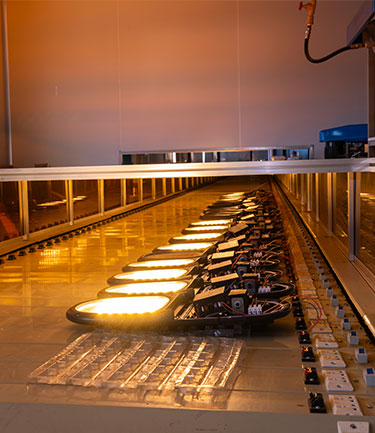
Luxific positions itself as a professional LED outdoor lighting Manufacturer and Supplier, with a factory established in 1999 and capabilities covering LED street lights and other outdoor lighting products. Its documented services include customizable solutions and OEM and ODM support covering product design, materials, dimensions, colors, branding and packaging.
6. Practical Selection Checklist for New-build and Retrofit Projects
Before approving an LED street light fixture, project teams can use the following checklist:
- Road width and classification confirmed
- Target illuminance or luminance defined
- Uniformity requirement confirmed
- Pole height and spacing available
- Mounting interface verified
- Suitable Type I to Type V optical distribution evaluated
- Cutoff and glare requirements reviewed
- IES or LDT photometric file received
- Photometric calculation completed
- Required certifications verified for the destination market
- Quantity and delivery schedule confirmed
- OEM, ODM or Customizable requirements identified where necessary
Design the Lighting System Before Buying the Fixture
The best LED street light fixture is not simply the one with the highest lumen rating or lowest price. It is the one that delivers the required illuminance, luminance and uniformity through the correct pole arrangement and verified optics. Luxific supports project-focused street lighting with manufacturing, customization, OEM and ODM capabilities.
Request a Project-Based Selection
Send your road dimensions, pole height, target illuminance, quantity, required market certifications and delivery schedule to Luxific. We can use these project inputs to recommend suitable fixtures, optics and configurations and prepare a quotation.