
Street lights are one of the most widely distributed and longest-operating urban public infrastructures. They are not only an important carrier of urban lighting but also a key foundation for promoting green and low-carbon development. Traditional street lighting management models face problems such as high energy consumption, low efficiency, and delayed fault detection, making them increasingly unable to meet the needs of modern urban development. With the advancement of smart city construction and green low-carbon initiatives, smart street lights, supported by technologies such as the Internet of Things (IoT), intelligent control, and wireless communication, enable intelligent management, energy-efficient operation, and efficient maintenance of lighting facilities, driving urban lighting toward a smarter and greener future.
I. Problems with Traditional Street Lighting
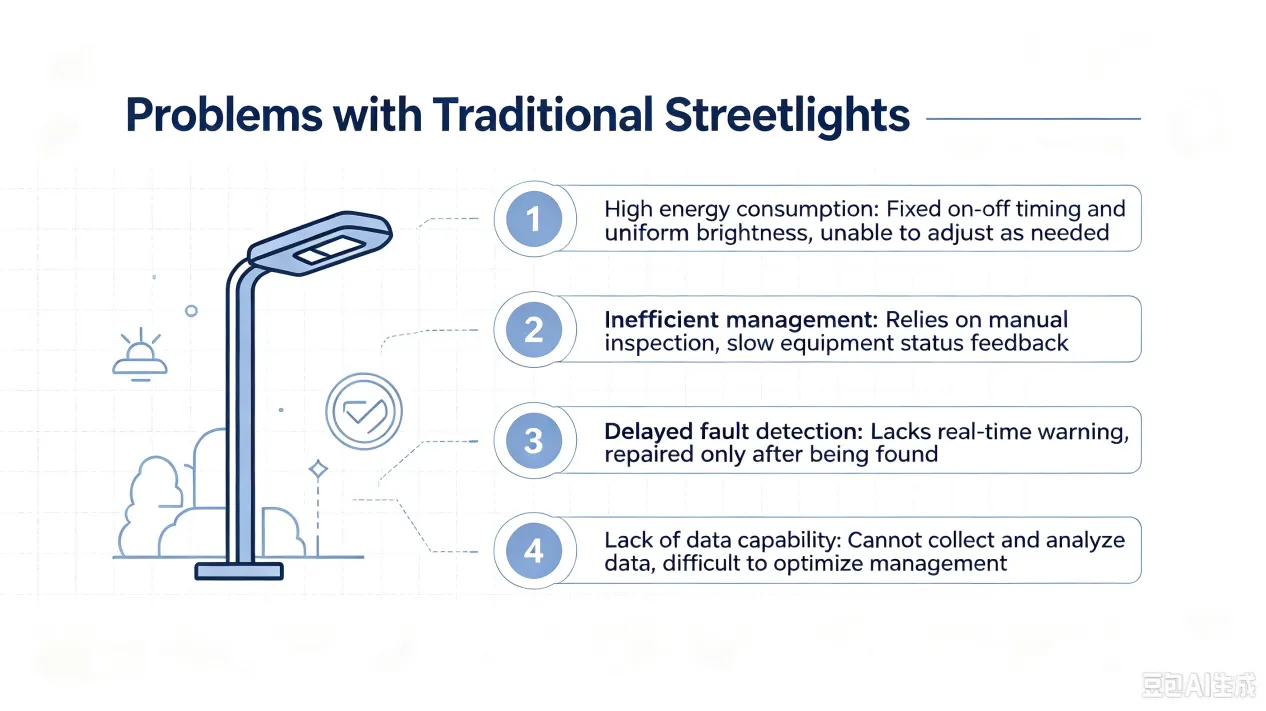
1. High Energy Consumption and Limited Energy-Saving Capability
Traditional street lights usually adopt fixed switching schedules and unified brightness control methods, which cannot dynamically adjust lighting based on environmental brightness, weather conditions, road traffic flow, or pedestrian activity. For example, during low-visibility conditions such as rainy or foggy weather, lighting requirements may change, but traditional systems cannot respond in time, potentially causing insufficient lighting or unnecessary energy waste and reducing operational efficiency.
2. Low Management Efficiency and Dependence on Manual Inspection
Traditional street lighting systems mainly rely on manual inspections and scheduled maintenance for management. Considering the wide coverage of urban areas and the large number of lighting devices, inspection tasks are labor-intensive and inefficient. Management personnel have difficulty obtaining real-time information about the operating status of each street light. When lamp failures, power supply problems, or cable faults occur, repairs usually can only begin after manual discovery, resulting in delayed response and increased maintenance costs.
3. Delayed Fault Detection and High Maintenance Costs
Traditional street lights lack real-time monitoring and fault warning capabilities. When abnormalities occur in lamps, power supplies, or circuits, problems are usually discovered only through manual inspections or public feedback. Due to difficulties in fault identification and long response times, these issues not only affect normal road lighting but also increase the workload and maintenance expenses for operation teams.
4. Lack of Data Management Capability
Traditional street lighting systems generally lack data collection and analysis capabilities, making it difficult to obtain real-time information about equipment status, energy consumption, and usage patterns. Management personnel cannot fully understand lighting system performance or optimize operations based on data analysis, resulting in a relatively extensive and inefficient management approach.
II. What Is a Smart Street Lighting Management System?
A smart street lighting management system is an urban lighting management platform built on technologies such as the Internet of Things, wireless communication, cloud computing, big data, and intelligent control. By connecting, monitoring, and intelligently adjusting street lighting equipment, the system enables remote management, energy-saving control, and efficient operation and maintenance.
Unlike traditional street lights that rely on manual inspection and scheduled switching, smart street lighting management systems can collect real-time information on lighting status, energy consumption, and environmental conditions. Through a centralized management platform, they provide functions such as remote switching, intelligent dimming, fault alarms, energy consumption analysis, and equipment maintenance management, significantly improving the automation and precision of urban lighting systems.
III. Main Components of a Smart Street Lighting Management System
1. Smart Street Light Terminals
Including LED lighting fixtures, controllers, sensors, and other components, responsible for lighting control and data collection.
2. Communication Network
Using communication technologies such as 5G, NB-IoT, and LoRa to enable data transmission between devices and the management platform.
3. Smart Management Platform
A cloud-based platform that provides centralized management of street lights, including remote control, data analysis, and fault monitoring.
4. User Application Interface
Management personnel can use computers, mobile phones, and other terminals to monitor street light status and perform operation and maintenance management.
III. Core Advantages of Smart Street Lighting Systems
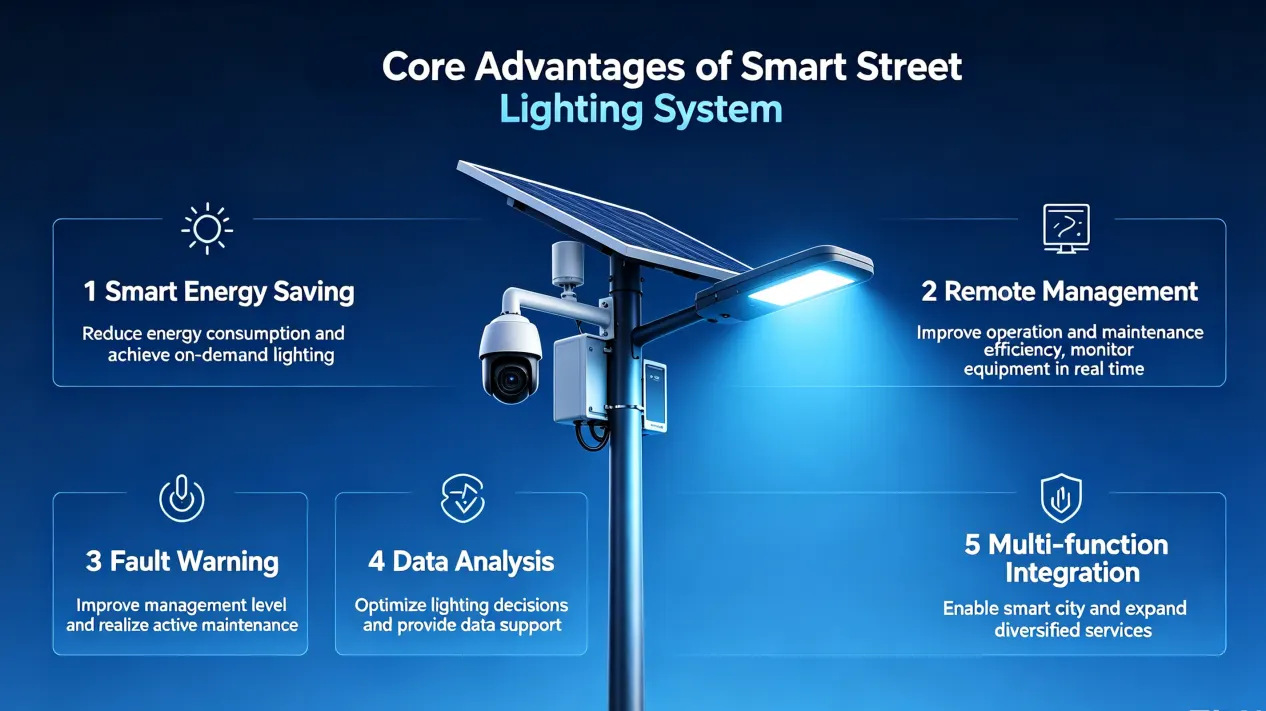
Smart street lighting management systems use IoT, intelligent control, and data analysis technologies to transform urban lighting management from traditional manual operation into digital and intelligent management. They provide significant advantages in energy saving, maintenance efficiency, and urban governance.
1. Intelligent Energy Saving and Reduced Energy Consumption
Smart street lights can automatically adjust lighting levels according to environmental brightness, weather conditions, and vehicle and pedestrian flow. For example, brightness can be reduced when roads are less occupied and increased when vehicles or pedestrians are detected, achieving “on-demand lighting.”
This intelligent control method reduces unnecessary electricity consumption and improves energy utilization efficiency.
2. Remote Management and Improved Maintenance Efficiency
Through a unified management platform, operators can monitor street light operating conditions in real time and perform remote switching, brightness adjustment, and equipment management. This reduces manual inspection requirements and improves maintenance efficiency.
3. Fault Warning and Improved Management Capability
The system can continuously monitor the status of lamps, power supplies, controllers, and other equipment, identify abnormalities in advance, and issue alerts. This enables a transition from “repair after failure” to “preventive maintenance,” reducing maintenance costs.
4. Data Analysis and Optimized Lighting Decisions
By collecting and analyzing street light operation data and energy consumption information, managers can understand urban lighting conditions and use data-driven insights to support energy optimization, equipment management, and urban planning.
5. Multi-Functional Integration Supporting Smart Cities
Smart street lights are not only lighting devices but also integrated smart infrastructure that can support functions such as environmental monitoring, traffic information display, public safety surveillance, and new energy vehicle charging, providing support for smart city development.
VI. Application Scenarios and Development Prospects
1. Urban Road Lighting
Smart street lights can be applied to urban main roads, expressways, and neighborhood streets. Through remote monitoring, intelligent dimming, and fault warnings, they enable precise lighting management, improve lighting quality, and enhance urban management efficiency.
2. Industrial Parks and Business Parks
Industrial parks often have extensive road networks and complex lighting requirements. Smart street lights can adjust lighting strategies according to different areas and time periods. Combined with energy monitoring and equipment management, they help reduce operational costs and improve the intelligence level of industrial parks.
3. Smart Communities and Residential Areas
In communities, parks, and other public spaces, smart street lights can integrate human detection and environmental monitoring functions to provide on-demand lighting, improve nighttime safety for residents, and enhance public service experiences.
4. Tourist Attractions and Commercial Areas
Smart street lights can provide customized lighting solutions for scenic areas and commercial streets through intelligent control and scenario-based lighting management. They can also support smart applications such as visitor flow analysis and environmental monitoring, improving regional management capabilities.
5. Highways and Transportation Applications
In highways, tunnels, transportation hubs, and other traffic-related environments, smart street lights can dynamically adjust lighting according to traffic flow and environmental changes, improving road safety while reducing long-term energy consumption.
In the future, with the continuous development of IoT, artificial intelligence, 5G communication, and renewable energy technologies, smart street lights will evolve from traditional lighting equipment into comprehensive urban intelligent terminals. Through AI algorithms and big data analytics, smart street lights will achieve more precise lighting control, energy optimization, and intelligent maintenance, further improving the energy efficiency and management performance of urban lighting systems.
At the same time, street light poles will gradually become important infrastructure nodes for smart cities, integrating multiple functions such as environmental monitoring, video sensing, smart charging, and communication base stations. This will promote the digital transformation of urban infrastructure and enable street lights to evolve from simple lighting facilities into comprehensive intelligent service nodes.
The smart street lighting management system effectively addresses problems in traditional lighting management, such as high energy consumption, low management efficiency, and delayed fault detection. It enables digital, intelligent, and refined urban lighting management and plays an important role in energy conservation, carbon reduction, smart operation and maintenance, and urban management optimization.
With the continuous advancement of green development and urban digitalization, smart street lights will no longer be limited to lighting functions. Instead, they will gradually develop into intelligent urban infrastructure integrating data collection, intelligent control, and public services. Through technological integration and expanded functionality, smart street lights will help cities achieve more efficient, energy-saving, and intelligent sustainable development, providing strong support for future smart city construction.