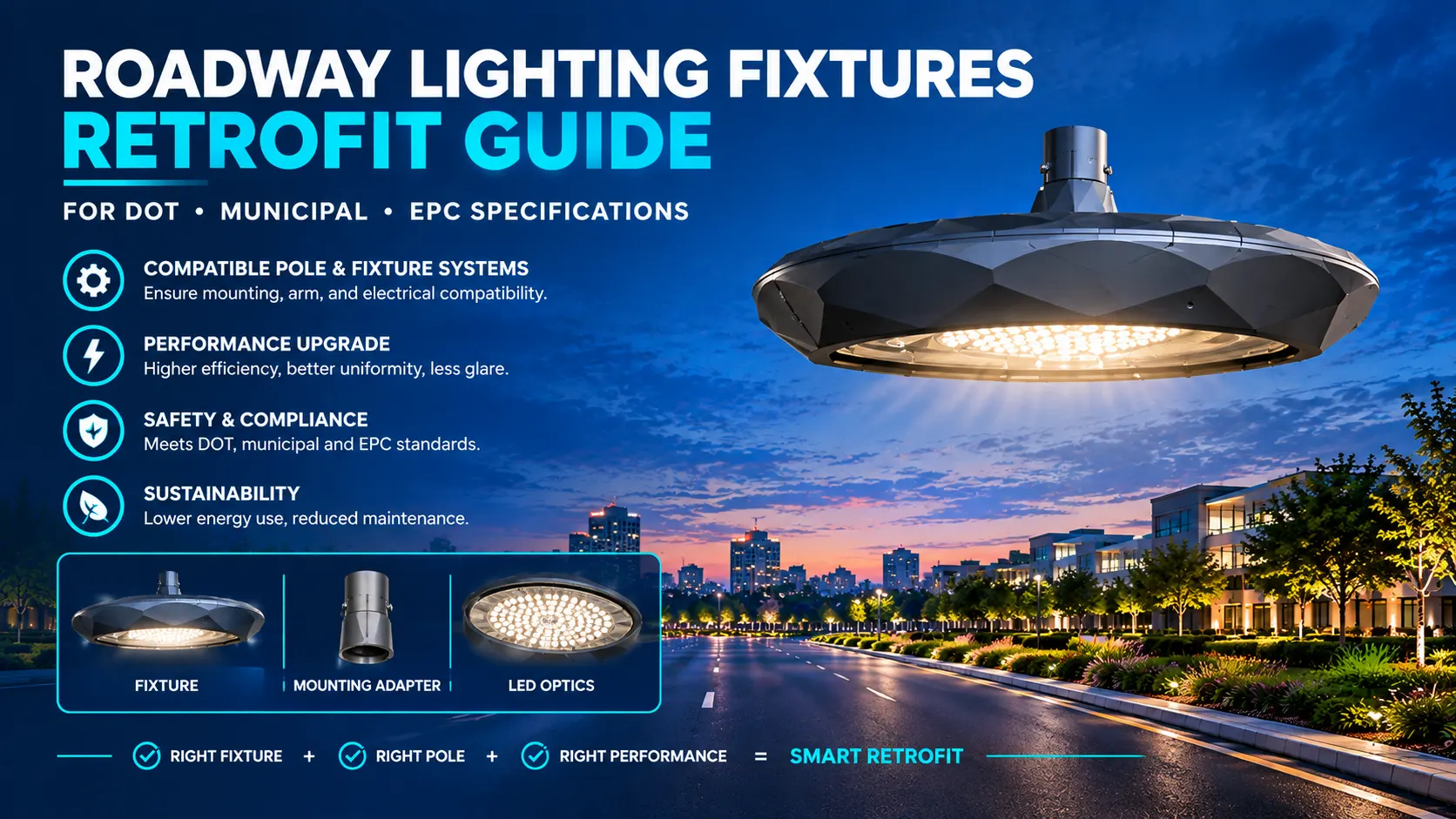
Replacing HPS or MH roadway fixtures sounds straightforward until an existing retrofit fails to meet the required illumination, mounting geometry, glare limits, or project documentation. For DOTs, municipalities, and EPC contractors, an unsuitable replacement can mean redesign, field corrections, higher maintenance costs, and schedule delays. The safer approach is to audit the existing installation, verify photometrics, confirm mechanical compatibility, and evaluate lifetime cost before approving the retrofit.

The best roadway lighting retrofit is selected by photometric performance, pole and electrical compatibility, compliance documentation, maintenance requirements, and lifecycle cost—not simply by replacing HPS or MH watts with LED watts. Luxific supports project-specific LED street lighting with photometric analysis, customizable configurations, OEM and ODM services, and certification documentation.
1. Audit Existing Poles and Electrical Supply Before Selecting Fixtures
A retrofit should begin with the existing infrastructure rather than the fixture catalog. For DOT and municipal projects, the pole, arm, wiring, supply voltage, mounting arrangement, and environmental conditions can determine whether a luminaire is genuinely suitable.
What to Document on Site
- Pole height, spacing, arm length, and outreach
- Existing fixture type, mounting diameter, and installation orientation
- Road width, lane arrangement, median configuration, and sidewalk position
- Existing electrical supply and operating voltage
- Current HPS or MH wattage and fixture quantity
- Environmental conditions such as temperature, rain, snow, dust, salt exposure, or coastal conditions
- Existing photocell, NEMA socket, Zhaga interface, or lighting control system
This audit reduces the risk of discovering compatibility problems after delivery. Luxific street lighting platforms can be configured with options such as photocells, NEMA sockets, Zhaga interfaces, DALI, 0-10V, Astro Dim, and Step Dim controls. One Luxific roadway luminaire specification also includes IP66 protection, IK09 impact resistance, and 10KV, 10KA surge protection.
Retrofit Audit Checklist
| Item | Why It Matters | Project Action |
|---|---|---|
| Pole and arm | Determines mounting and structural compatibility | Record height, outreach, diameter, and condition |
| Electrical supply | Determines driver compatibility | Verify voltage, frequency, wiring, and protection |
| Road geometry | Controls optical requirements | Measure road width, spacing, and mounting height |
| Existing controls | Impacts smart retrofit integration | Identify photocell, NEMA, Zhaga, or control protocol |
2. Replace HPS or MH by Photometrics, Not by Watts

One of the most common retrofit mistakes is treating LED wattage as a direct replacement for HPS or MH wattage. Wattage measures electrical consumption, while lux describes illumination received across a defined area. A successful roadway retrofit therefore needs to demonstrate the required light distribution and uniformity through photometric analysis.
Start With the Lighting Requirement
- Define the applicable DOT, municipal, or project lighting criteria.
- Collect road width, pole height, pole spacing, and fixture position.
- Define the target illuminance and uniformity requirements.
- Select an appropriate LED optical distribution.
- Run a photometric simulation before final approval.
- Compare the proposed LED design with the existing installation.
Luxific roadway fixtures offer multiple optical distributions, including Type I through Type V, allowing the light pattern to be matched to different roadway geometries. The company also provides photometric analysis as part of project-oriented solutions.
Why Optical Distribution Matters
A higher-power fixture does not automatically produce better roadway lighting. If the beam is too narrow, dark areas can appear between poles. If the distribution is too wide, light may spill outside the roadway. The objective is controlled illumination where drivers and pedestrians need it, while limiting unnecessary glare and trespass.
Luxific documentation distinguishes lumens from lux: lumens describe total light output, while lux describes the amount of light falling on a specific area. This distinction is fundamental when evaluating roadway retrofit performance.
3. Verify Bracket, Tilt and Optical Compatibility

Even a high-quality LED luminaire can perform poorly if the mounting angle or bracket geometry is wrong. Retrofit specifications should therefore cover both mechanical installation and optical aiming.
Check These Compatibility Points
- Slip-fitter or bracket dimensions
- Horizontal or vertical mounting requirements
- Available tilt adjustment
- Arm diameter and insertion depth
- Fixture weight and wind-load considerations
- Optical distribution relative to road geometry
- Clearance from nearby structures and trees
For retrofit projects, customizable brackets can be especially valuable when the existing pole infrastructure must remain unchanged. In one Luxific industrial-port project, the team designed a specific bracket for existing high-mast poles and supplied a photometric analysis to verify coverage and light trespass.
Use Customization When Standard Fixtures Are Not Enough
Municipal projects may involve legacy poles, unusual arm dimensions, or branded procurement requirements. Luxific provides OEM and ODM services covering project-oriented design, dimensions, materials, colors, branding, packaging, prototyping, and technical design.
This makes a Customizable solution practical when the project specification requires more than a standard catalog fixture. A qualified Manufacturer or Supplier should be able to explain exactly which mechanical and optical changes are being proposed rather than simply offering a higher-wattage alternative.
4. Verify Energy, Maintenance and Payback
A roadway retrofit should be evaluated using lifecycle economics rather than purchase price alone. For municipalities and EPC contractors, the real comparison includes fixture cost, installation, electricity consumption, replacement frequency, maintenance access, and expected service life.
Lifecycle Evaluation Framework
| Cost Factor | Retrofit Question | Evidence to Request |
|---|---|---|
| Energy | How much power will the proposed system consume? | Rated wattage and operating schedule |
| Maintenance | How often will access or replacement be required? | Warranty and maintenance recommendations |
| Performance | Will illumination remain suitable for the project? | Photometric report and optical data |
| Reliability | Can the fixture withstand the installation environment? | IP, IK, surge and environmental specifications |
| Compliance | Can the product satisfy procurement requirements? | Applicable certificates and test reports |
Luxific identifies low maintenance cost, long service life, energy efficiency, and reliable outdoor performance as important LED street lighting benefits. Its product documentation also lists certifications and testing references including CE, CB, ENEC, EMC, TM21, LM79, and IEC-62471 for a roadway luminaire platform.
Do Not Evaluate Payback From Energy Alone
A better retrofit calculation includes energy savings plus avoided maintenance and replacement work. This is particularly important when poles are difficult to access or roads must remain operational during maintenance. Luxific has also documented projects where technical testing and site trials were used before full deployment, including a Canadian project exposed to temperatures down to -40°C.
5. Select a Supplier That Can Support the Specification
For DOT, municipal, and EPC procurement, the supplier should support the project beyond quotation. Technical communication, documentation, samples, customization, production control, and logistics can directly affect project execution.
- Request complete technical datasheets before approval.
- Confirm the exact certification and test documentation required by the project.
- Ask for photometric files and simulation support.
- Confirm mounting and electrical compatibility.
- Clarify warranty terms and technical support.
- Verify production and delivery capability before issuing the purchase order.
Luxific describes itself as a professional LED outdoor lighting Manufacturer and factory established in 1999, with OEM and ODM capabilities, in-house R&D, quality testing, and technical support. Its company materials also state that its products are supplied with international certification documentation.
Manufacturer, Supplier or Wholesaler: What Should Project Buyers Look For?

A Wholesaler may be suitable for standard replacement purchases, but specification-driven roadway projects often require deeper technical support. A direct Manufacturer can provide greater visibility into customization, testing, production, and engineering coordination. For complex projects, the priority should be documented capability rather than the supplier label alone.
6. A Practical Retrofit Approval Sequence
- Audit the existing roadway and pole infrastructure.
- Confirm electrical and mechanical compatibility.
- Define the applicable project lighting requirements.
- Select LED optics based on road geometry rather than wattage alone.
- Complete photometric analysis.
- Review glare, uniformity, mounting angle, and light trespass.
- Verify certifications, testing, warranty, and environmental ratings.
- Approve samples or field trials where the project risk justifies them.
- Confirm production, logistics, and delivery schedule.
- Evaluate energy and maintenance savings as part of the lifecycle cost.
Conclusion: Build the Retrofit Around the Road, Not the Fixture
For your roadway retrofit, send Luxific the road dimensions, pole height, target illuminance, quantity, required market certifications, and delivery schedule. Our team can use these inputs to recommend a suitable LED roadway fixture, optical configuration, customization approach, and quotation.